

You sat in the exam room and heard “your labs look fine.” Then you drove home still tired, still achy, still wondering why this is what 68 feels like.
Millions of seniors are living with fatigue, bone pain, brain fog, and low mood that their doctors are calling “aging.” The real cause is often a vitamin deficiency that a single blood test can confirm.
Adults over 60 who have started accepting decline as normal deserve to know that. This article is for you.
Vitamin D deficiency in seniors is one of the most widespread and most overlooked conditions in routine medicine. Here is what to do about it.
☀️ Vitamin D Deficiency Checker
Discover whether your symptoms and lifestyle may put you at risk for low Vitamin D levels, then instantly decode your 25(OH)D blood test result.
Symptoms
Risk Factors
Your Risk Score
25(OH)D Lab Result Decoder
Quick Reference
Under 20 ng/mL — Deficient
20–29 ng/mL — Insufficient
30–50 ng/mL — Optimal
51–100 ng/mL — High
Over 100 ng/mL — Potentially Excessive
The Symptoms You've Been Calling "Aging" May Have a Name

You've started calling it "just getting older." But there is a good chance it has a more specific name.
Vitamin D deficiency produces four symptoms that look, feel, and sound exactly like normal aging. Those symptoms are constant fatigue, bone and muscle pain, mental fog, and a low or flat mood.
Most people with low vitamin D don't feel dramatically sick. They just feel off. Less energy than they expect. A heaviness in their legs climbing stairs. A brain that takes a little longer to find words.
Your body can't tell you it's low on vitamin D. It can only give you symptoms. And those symptoms, one by one, get filed under "aging."
Here is why that matters. More than half of Americans over 50 have vitamin D levels that are too low. Most of them don't know it.
You feel tired. You ache. You're not as sharp as you were. That is a profile. That profile has a name. And a test.
Why Your Doctor Probably Didn't Test for It
You had blood drawn. The results came back normal. So why do you still feel this way?
Because a standard blood panel doesn't include a vitamin D level unless your doctor specifically adds it. It is not checked by default.
The 2024 Endocrine Society guideline actually recommends against routine vitamin D screening in healthy adults without specific medical reasons for it. Doctors following that guideline are not making a mistake. But that guideline was designed for healthy adults who show no symptoms. It was not designed for you.
If you've gone to your doctor feeling tired and run-down and were told your labs look fine, your vitamin D may simply not have been part of those labs.
That's the gap. It's not personal. It's not negligence. It's a systemic blind spot.
The test exists. It's called a 25-hydroxyvitamin D test. You just have to ask for it.
So I have to ask for it myself.
Yes. You do.
Why Seniors Are the Highest-Risk Group

Here is the contradiction. You're retired. You have time to go outside. The sun is right there. And your body still can't get enough vitamin D from it.
That's because aging changes the biology of how vitamin D is made, converted, and used. It happens in five ways, and they all work against you at once.
Why Vitamin D
Drops With Age
Your skin makes less
As you age, your skin contains fewer of the molecules needed to convert sunlight into vitamin D. Production can drop by more than 50% compared to younger adults.
Your kidneys convert less
Vitamin D from your skin or food has to be activated by your kidneys. Kidney function slows with age, and so does that conversion.
Your gut absorbs less
The aging digestive system is less efficient at pulling fat-soluble nutrients out of food. Vitamin D is fat-soluble.
Less time in direct sun
Mobility changes, indoor living, and protective clothing all reduce sun exposure.
Medications interfere
Some common medications interfere. Proton pump inhibitors, corticosteroids, and certain cholesterol drugs can reduce vitamin D levels or block its conversion.
Globally, nearly 6 in 10 elderly people fall below the deficiency threshold for vitamin D. That's one of the highest deficiency rates of any nutrient in this age group.
This is not a personal failure. This is what happens to a human body after 60.
What Happens to Your Body When the Deficiency Goes Uncorrected

Vitamin D isn't one thing. It's infrastructure. Your bones, muscles, mood, and immune system all depend on it.
When levels stay low for a long time, the effects compound. Here is what the research shows, system by system.
The Risks of
Low Vitamin D
Your Bones Weaken
Vitamin D helps your body absorb calcium. Without enough of it, calcium absorption drops and bones lose density. That raises your fracture risk.
Muscles Lose Strength
Low vitamin D is linked to muscle weakness and poor physical function in older adults. The American Geriatrics Society cites a 25(OH)D level below 20 ng/mL as associated with higher fall rates.
Your Mood Shifts
Research consistently shows an association between low vitamin D and depressive symptoms in older adults. A 2024 meta-analysis found that supplementation significantly reduced depressive symptom scores in people who were deficient.
Immune Vulnerability
Vitamin D plays a role in immune defense. Deficiency is associated with greater vulnerability to illness. The goal is correcting deficiency, not chasing prevention claims.
Your Overall Risk Rises
In a study of more than 11,000 Americans between 50 and 79, those with true vitamin D deficiency had a 38% higher risk of dying from any cause than those with sufficient levels, even after accounting for other health factors.
None of this is permanent if the deficiency is found and corrected.
The One Test That Tells You Your Number
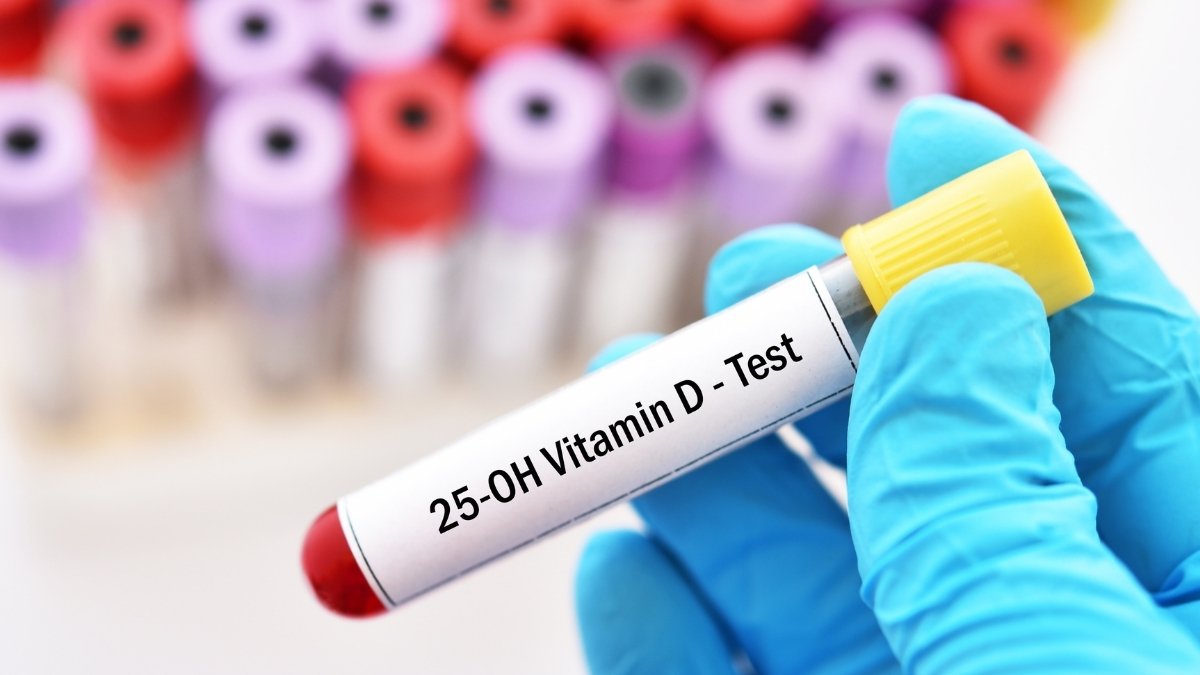
The test is called a 25-hydroxyvitamin D test. You may also see it written as 25(OH)D or serum vitamin D. It measures the amount of vitamin D stored and circulating in your blood.
It is a standard blood draw. Ask your doctor to add it to your next panel.
Here is what your number means:
- Below 20 ng/mL: Deficient. Most clinicians agree this level requires correction.
- 20 to 29 ng/mL: Insufficient. Your levels are low but not critically so. Action is still recommended.
- 30 ng/mL and above: Generally sufficient for bone and muscle health. The American Geriatrics Society recommends this as the minimum target for older adults at risk of falls or fractures.
Note: The 2024 Endocrine Society guideline says there is not yet enough evidence to set firm targets for disease prevention. So these thresholds are widely used in clinical practice, but the science is still evolving. Bring your actual number to your doctor and ask what it means for you specifically.
Don't accept "normal" as an answer. Lab ranges vary. Some labs call anything above 20 ng/mL normal. Ask for the exact number. Write it down.
You have the number. Now: what do you actually do with it?
Your Vitamin D
Test Reference Card
Ask For
25-hydroxyvitamin D test (25(OH)D)
Talk to your doctor about correction.
Supplementation likely needed.
Generally sufficient. Confirm with your doctor.
Ask for the exact number, not just "normal" or "fine."
Retest after 8 to 12 weeks if you start a supplement.
How to Correct It: What the Research Actually Supports

You are not adding a medication. You are replacing something your body used to make on its own and now can't, because modern life separated you from the sun.
Before changing your supplement routine, talk to your doctor first. This is especially important if you take medications, manage a chronic condition, or have kidney disease.
Choose the right form. Look for vitamin D3, also called cholecalciferol. It is absorbed better and stays in your system longer than vitamin D2.
Start with a reasonable daily dose. The Institute of Medicine recommends 800 IU per day for adults over 70. The American Geriatrics Society recommends at least 1,000 IU per day for older adults living in the community. Your doctor may recommend more based on your test result.
Take it daily, not in large doses once a month. High-dose intermittent vitamin D supplementation has not been shown to reduce falls or fractures in older adults and may increase risk in some cases. Daily, lower-dose supplementation is what the 2024 Endocrine Society guideline supports for adults over 75.
Wait 8 to 12 weeks before retesting. Vitamin D levels take time to stabilize. Testing too early gives a false reading.
Food helps but usually isn't enough. Fatty fish, egg yolks, and fortified milk all contain small amounts of vitamin D. They can support your levels, but they rarely correct a true deficiency on their own.
The 2024 Endocrine Society guidelines specifically recommend that adults over 75 supplement empirically, meaning even without a confirmed deficiency, because the data support it for this age group.
The next step is a phone call, not a trip to the supplement aisle.
Final Words,
Call your doctor this week. Ask for a 25-hydroxyvitamin D blood test. Know your actual number, because a number you can act on is the only thing standing between where you are now and how you could feel. Vitamin D deficiency in seniors is fixable. You just have to find it first.
Disclaimer
This article is for informational purposes only and does not constitute medical advice or a recommendation to use any supplement. The content addresses vitamin D deficiency identification and supplementation in older adults and is intended for general educational purposes only.
Supplements can interact with medications and may not be appropriate for everyone — always consult a licensed healthcare provider before starting, changing, or stopping any supplement regimen.