

The most expensive longevity mistake is not something you buy. It is something you do every day without thinking about it.
Three ordinary habits quietly suppress your hypothalamic rhythms, the daily timing signals that run your sleep, hunger, body temperature, and hormones. When that timing slips, you feel it as broken sleep, afternoon crashes, and an appetite that never settles.
After 50, the problem gets harder to spot. The lens of your eye lets in less blue light, your days drift indoors, and your brain’s master clock gets weaker signals to work with. Your clock is left guessing.
Then the evening makes it worse. In one Harvard affiliated study of healthy young adults, ordinary room light before bed shortened the body’s melatonin signal by about 90 minutes.
Here is the part most people miss. The fix costs nothing, takes only minutes, and starts with something simple you do before breakfast.
Your Hypothalamic Rhythms Run on a Master Clock
Deep in your brain, just above the spot where the optic nerves cross, sits a cluster of about 20,000 neurons called the suprachiasmatic nucleus. It lives inside the hypothalamus, and researchers call it the master clock of the body.
That clock does far more than tell you when to sleep. It helps time attention, hormone release, body temperature, melatonin, and the sleep wake cycle.
It also keeps the rest of your body in step. Nearly every cell carries its own small clock, and the master clock acts like a conductor so every organ plays on the same beat.

The conductor takes its cues from your eyes. Specialized light sensing cells in the retina send signals straight to the master clock, and they respond most strongly to the blue part of daylight.
Here is the catch for anyone over 50. The lens of the eye yellows with age and lets through less blue light, and many older adults spend more of the day indoors.
Researchers describe earlier sleep timing, flatter daily rhythms, and more fragmented rest as common changes with age. Estimates in the research literature put sleep disturbances at 40% to 70% of older adults.
When light, food, and sleep signals blur together, the daily swing between alert and sleepy gets flatter. Scientists call this a lower amplitude, and it is one reason the three habits below matter more at this stage of life, not less.
Here is the quick view before the details.
The Circadian Disruption Matrix
How everyday routine missteps send confusing mixed signals to your internal master clock and throw off vital biological rhythms.
Dim, Indoor Mornings
“The day has not really started yet.”
Sleep stability, peak daytime activity, and natural bedtime.
Bright Light After Dark
“It is still daytime outside.”
Melatonin production, sleep onset time, and sleep efficiency.
Drifting Meals & Bedtimes
“Timing is completely unpredictable.”
Hunger hormones, metabolic calorie burn, and sleep regularity.
1. Starting Your Day in Dim Indoor Light
Habit one looks harmless. You wake up, shuffle to the kitchen, scroll your phone, and do not step outside until late morning.
Your master clock reads that as a morning that never quite arrived.
Light is the strongest timing cue the clock has. Bright light early in the day nudges the clock earlier and gives the day a clean starting line, while light in the evening pushes it later.

The problem is brightness. Many indoor rooms sit in the low hundreds of lux, while even a cloudy day outdoors usually lands in the thousands.
A kitchen that looks bright to you is still dim by your master clock’s standards.
What Happens When Older Adults Get More Daytime Light
A University of Surrey study, published in 2025 in the journal GeroScience, followed 36 adults aged 60 and older who lived at home and had sleep complaints. Over several weeks, they used light boxes for two hours in the morning and two hours in the evening.
Longer morning exposure to blue enriched light improved the stability of their daily rest and activity rhythms. It also reduced fragmented sleep.
Timing mattered too. Starting morning light later was linked to later bedtimes and lower sleep efficiency.

Time spent in light above 2,500 lux, a rough stand in for being outdoors, was linked to more daytime activity, better sleep efficiency, and earlier bedtimes.
A smaller pilot study of 14 senior home residents pointed the same way. Residents with more light exposure between 6 a.m. and noon had steadier, less fragmented daily rhythms.
Both studies were small, so treat them as strong hints rather than final proof.
The Morning Hormone Connection
Your hypothalamic clock also schedules the daily cortisol cycle. The hypothalamus signals the pituitary, the pituitary signals the adrenal glands, and the master clock sets the rhythm for that whole chain.

In most healthy people, cortisol climbs soon after waking and peaks within the first hour, rising roughly 38% to 75% above waking levels.
A strong light signal early in the day helps anchor the clock that times this hormone wave.
The Free Fix
Get outside within the first hour of waking. Drink your coffee on the porch, walk to the mailbox the long way, or water the garden.
If you cannot get outside, sit beside the brightest window you have. Glass dims the light, so outdoors is still better.

Light boxes are another route, but ask your doctor first, especially if you have an eye condition.
Pay attention to your eyes too. Dull or yellowed colors and glare at night can be signs of cataracts, and a clouded lens lets even less light through to your clock.
2. Staying Under Bright Light and Screens After Dark
Habit two is the mirror image of habit one. The overhead lights stay on, the TV glows, and the phone comes along to bed.
To your master clock, all of that looks like daytime.
Melatonin is the hormone that signals the start of biological night. Researchers at Brigham and Women’s Hospital, a Harvard teaching hospital, tested what ordinary room light does to it.
They studied 116 healthy volunteers aged 18 to 30. For five days, the volunteers spent the eight hours before bed in either regular room light or dim light.
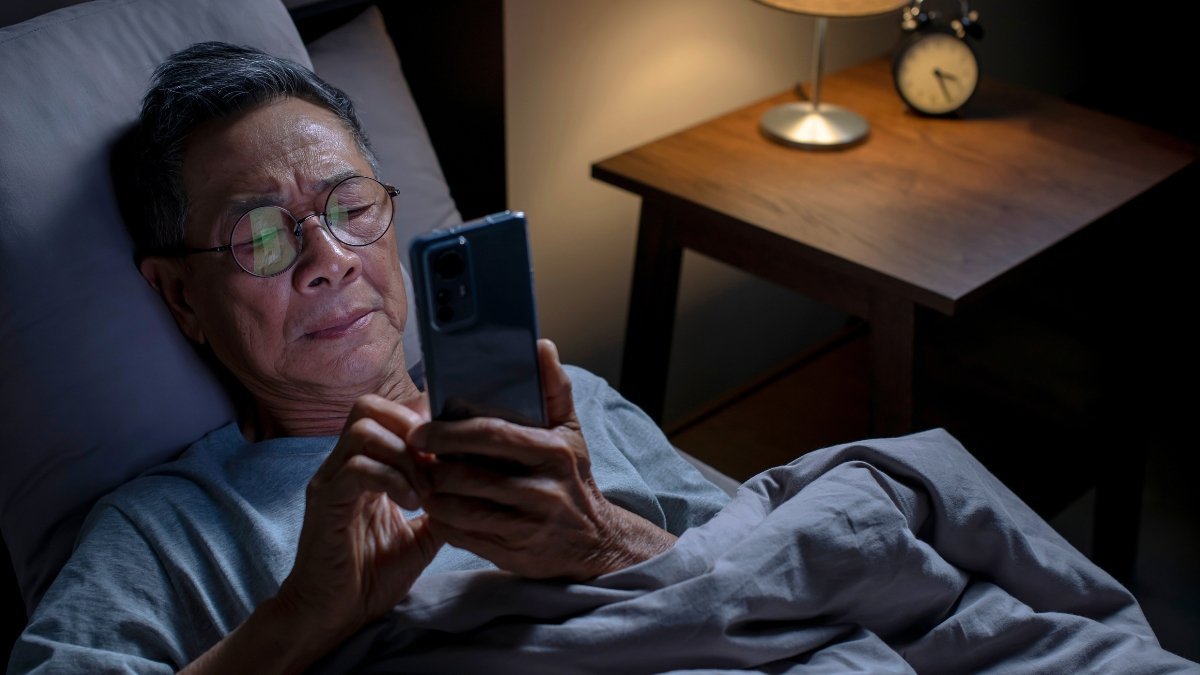
Compared with dim light, room light delayed the start of melatonin in 99% of people. It also shortened the length of the melatonin signal by about 90 minutes.
Room light during the usual hours of sleep suppressed melatonin by more than 50% in most trials. If you get up at night, a bright overhead light on the way to the bathroom is the kind of exposure the researchers were describing.
The authors noted that disrupted melatonin signaling could potentially affect sleep, body temperature regulation, blood pressure, and blood sugar control.
Does This Hold True After 60?
Those volunteers were young, so a fair question is whether older eyes react the same way. The Surrey study of adults aged 60 and older suggests evening light is still a problem.
In that study, longer evening light exposure was linked to a longer time to fall asleep and lower sleep efficiency. The researchers concluded that morning light helped, while evening light should be avoided.
Research is mixed on exactly how much aging dulls the response to light, so the safest move is simply to keep evenings dim.
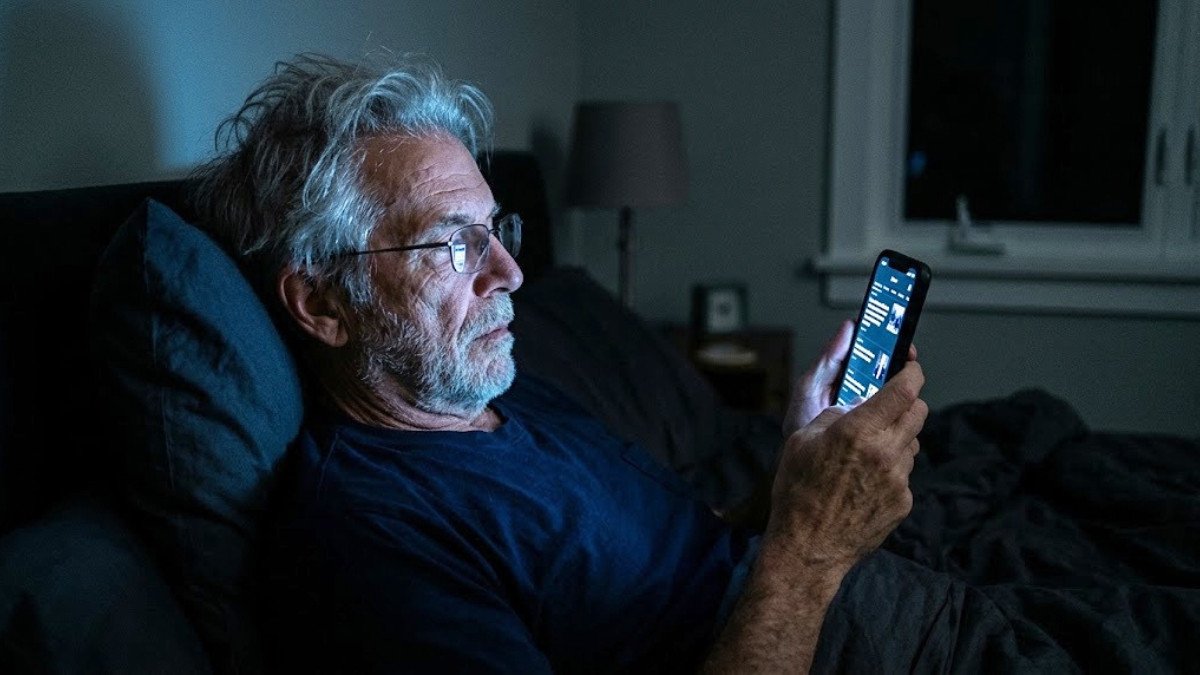
Screens add to the problem. Phones and tablets sit close to your face, and their output includes the blue wavelengths your clock responds to most.
Color matters too. A separate laboratory study compared bedroom level evening lighting and found that a light source with less blue output suppressed less melatonin than a standard fluorescent source.
The Free Fix
Dim the overhead lights after dinner and switch to lamps with warm bulbs. Move screens farther from your face, lower their brightness, and stop scrolling once you are in bed.

For nighttime bathroom trips, use a low amber night light instead of the overhead switch. Keep the light low and the trip short.
Everyone’s body responds differently, so check with your doctor before adjusting your light or meal routine if you take medication for diabetes, blood pressure, or sleep.
3. Letting Mealtimes and Bedtimes Drift
Habit three is the sneakiest. Dinner is at 6 p.m. on Monday and 9 p.m. on Friday, and bedtime moves around depending on what is on TV.
Your master clock thrives on routine. So do the clocks in your liver, gut, and fat tissue, which respond to when food arrives.
What a Late Dinner Did in a Controlled Trial
A 2022 randomized crossover trial in Cell Metabolism, led by Brigham and Women’s Hospital, tested meal timing directly. Sixteen adults with overweight or obesity ate the same meals on two schedules, one running four hours later than the other.
Sleep, light, posture, and physical activity were tightly controlled, so the timing of the meals was the main thing that changed.

Late eating lowered leptin, the hormone that signals fullness, across the full 24 hours. It also increased hunger, slowed calorie burn, and shifted gene activity in fat tissue toward storing more fat.
The trial was small and did not focus on seniors. Treat it as a clue about the mechanism, not a verdict on every late dinner.
Why a Steady Wake Time May Matter
Sleep timing carries its own signal. Researchers measure it with the Sleep Regularity Index, which shows how closely your asleep and awake pattern repeats from one day to the next.
A UK Biobank analysis of 88,975 adults with an average age of 62 linked irregular sleep and wake patterns to a higher risk of death.
A second analysis of 60,977 adults, average age about 63,

found that people in the four more regular fifths of the group had a 20% to 48% lower risk of dying from any cause than the least regular fifth. Sleep regularity also predicted mortality risk better than sleep duration did.
These are observational studies, so they show a link, not proof of cause. Illness can also make sleep less regular, so the direction of the link is still being worked out.
The Free Fix
Pick a wake time and hold it as closely as you can, weekends included. If your wake time swings by a couple of hours between weekdays and weekends, your clock is getting mixed messages.
Eat meals at roughly the same times each day. A practical target is finishing dinner about three hours before bed.
Try This Today: Give Your Master Clock a Clear Signal
- Step outside within an hour of waking, even if the sky is gray.
- After dinner, turn off the overhead lights and use warm lamps.
- Put a low amber night light in the hallway and bathroom.
- Choose a wake time you can repeat tomorrow, and pick a dinner time you can repeat all week.
A Day Your Master Clock Can Read
Here is how the three fixes fit into a normal day.
The Circadian Daily Routine Timeline
A step-by-step daily rhythm protocol to sync your central clock, optimize metabolism, and protect evening melatonin surge.
Within an hour of waking
Get outdoors or sit directly by the brightest available window.
Gives your central brain clock a powerful, unambiguous start signal.
Through the day
Spend more time in natural daylight, including an outdoor walk if possible.
More bright light exposure links directly to higher day activity & earlier bedtimes.
~3 hours before bed
Finish your last main meal/dinner of the day.
Keeps nighttime hunger signals and cellular metabolic burn on schedule.
After dinner
Dim overhead lights, switch to warm lamps, and lower screen brightness.
Protects the natural evening surge of sleep-inducing melatonin.
Every day (including weekends)
Keep your morning wake time strictly steady and consistent.
Anchors overall sleep regularity and long-term circadian stability.
When to See a Doctor
Better habits are a solid first step, but some signs deserve a professional opinion.
- Loud snoring with gasping or pauses in breathing during sleep
- Trouble sleeping that lasts more than a few weeks despite better habits
- Falling asleep unintentionally during the day, especially while driving
- Dull, yellowed colors or night glare that could point to cataracts
The Quiet Cost of Ignoring Your Clock
Your hypothalamus does not care about your supplement shelf. It cares about when light arrives, when food arrives, and whether tomorrow looks like today.
All three habits do the same thing: they blur the signals your master clock depends on. Dim mornings, bright nights, and a drifting schedule leave it guessing.
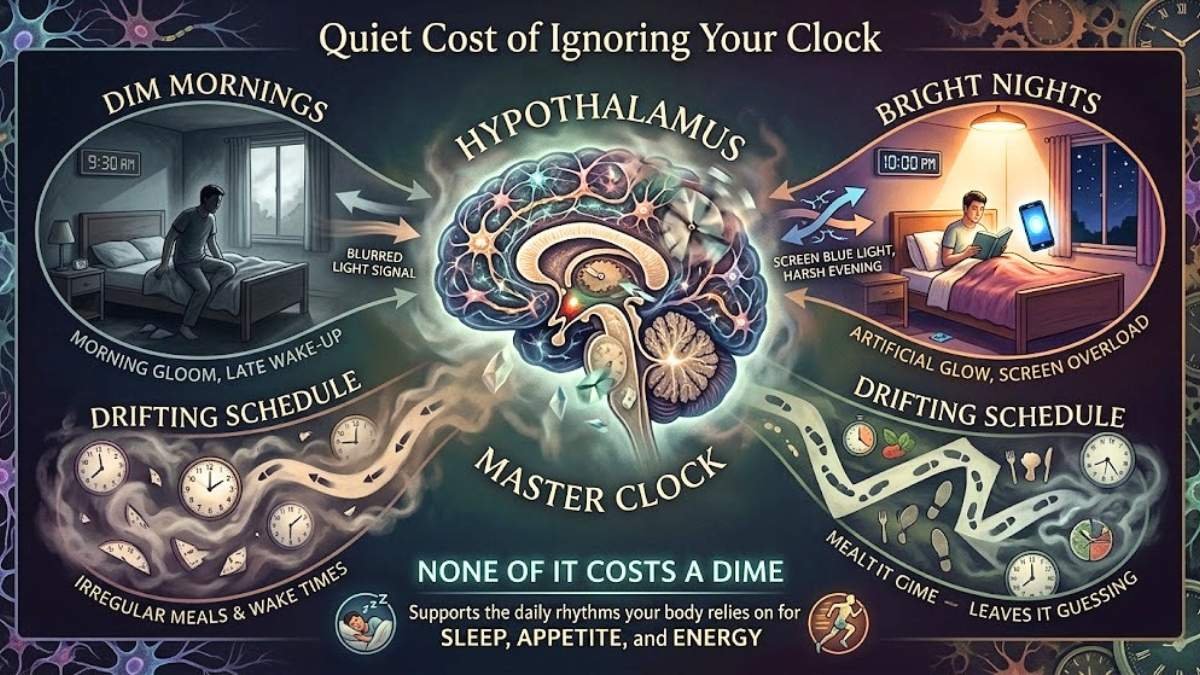
You do not have to fix everything at once. Start with morning light, then dim the evening, then anchor your mealtimes and wake time.
None of it costs a dime, and all of it supports the daily rhythms your body relies on for sleep, appetite, and energy.