

Adults over 60 can still build lean muscle, but the usual advice quietly fails most of them.
You lift a little, eat the way you always have, and nothing changes. Meanwhile, researchers estimate older adults lose roughly 0.7% to 0.8% of their muscle every year, and that loss steadily raises the risk of falls, fractures, and lost independence. Stairs get steeper, grocery bags get heavier, and getting out of a chair starts to take a plan.
Scientists have a name for why your muscles stopped responding: anabolic resistance. They also have a name for the way around it: the anabolic threshold. And it does not require a barbell.
This article explains what that threshold is, how to cross it at every meal, and how to train with light loads so your muscles finally get the message. It also tells you what the research does and does not say about that 30% claim.
What the Anabolic Threshold Actually Means
Young muscle responds to protein almost in a straight line. Eat a little more, build a little more.
Older muscle is pickier. That blunted response is called anabolic resistance, and it means the same meal that once fed your muscles may now fall short.
The key signal is leucine, an amino acid that switches on a growth pathway called mTORC1 inside muscle cells. Clinical studies show adults over 60 need about 2.8 grams of leucine in a meal, roughly 30 grams of protein, to turn muscle building on.
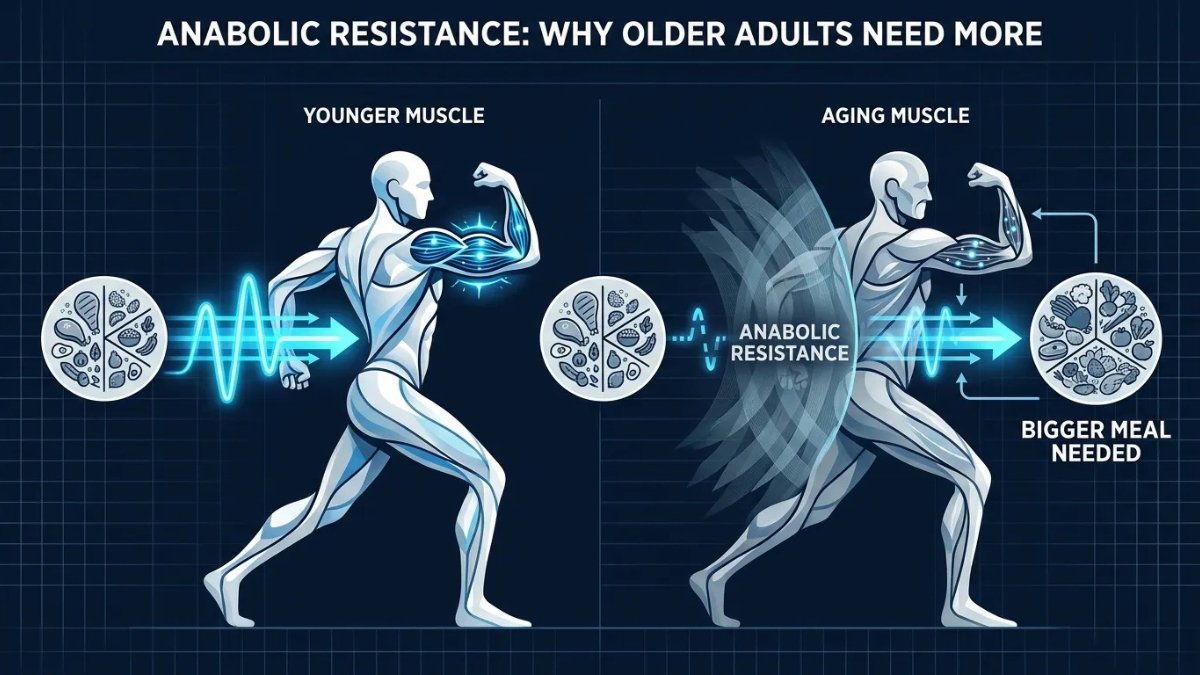
That line is the anabolic threshold. Below it, much of the protein goes to other jobs.
There is a second catch. The muscle building window after a meal lasts only about 2 to 3 hours, so one giant dinner cannot do the work of three solid meals.
Most people miss the mark. In a study of 327 older adults in Auckland, more than half ate less than the suggested 1.2 grams of protein per kilogram of body weight daily, and breakfast was the weakest meal.
Before changing how you eat or train based on this article, talk to your doctor, especially if you take medication, have kidney trouble, or manage a chronic condition.
Why Light Weights Can Still Build Muscle After 60
Muscle responds to effort, not just to the number printed on the dumbbell.
A 2017 systematic review and meta analysis compared light loads (60% of your one rep maximum or less) with heavy loads, with every set taken to momentary failure. Muscle growth turned out to be similar. Heavy loads still won for maximal strength.
Older adults show the same pattern. In one study, 51 untrained adults aged 57 to 75 trained twice a week for 12 weeks using only body weight and elastic bands.
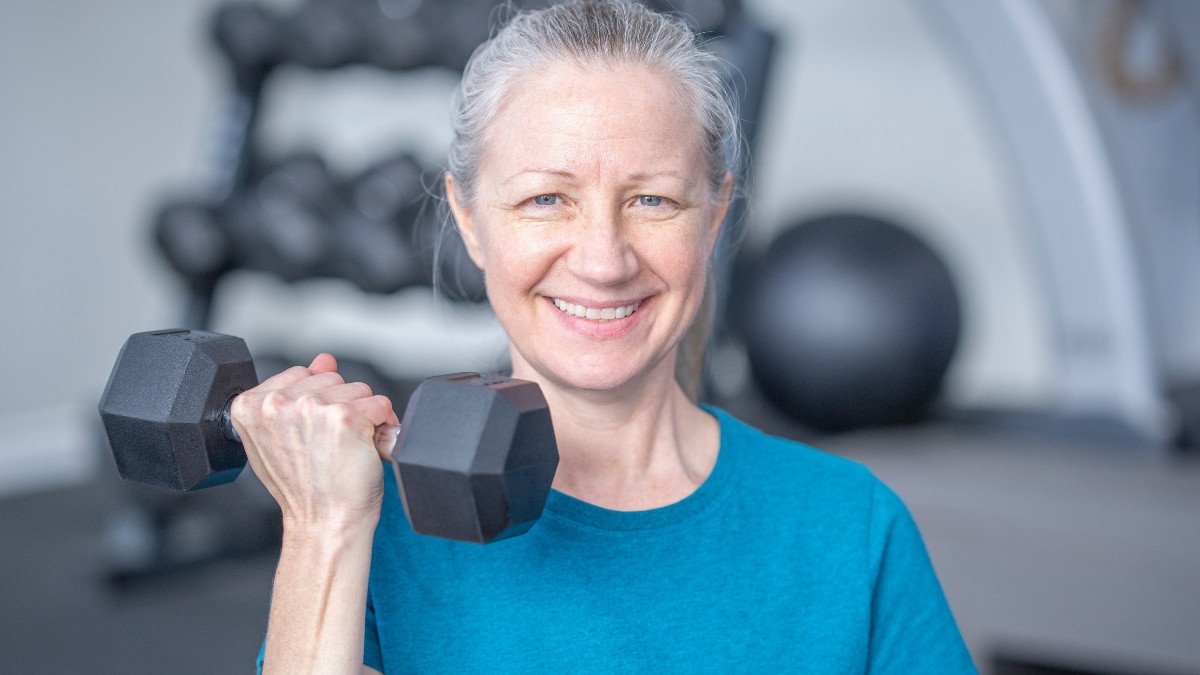
Their muscle size, strength, and physical function all improved.
Here is the catch. Light does not mean easy.
Light loads work when each set ends close to the point where one more rep would be hard. The Physical Activity Guidelines for Americans give the same advice: strength train 2 to 3 times a week, to the point where another repetition would be difficult.
Typical Advice vs. Anabolic Threshold Approach
Direct comparison between traditional fitness habits and evidence-based anabolic threshold targeting.
Small breakfast, huge dinner.
~30 g or more at every meal.
Heavy weights or nothing.
Light to moderate loads (15–25 reps).
Sets stop when they feel easy.
Sets finish close to failure.
Whenever convenient.
Best protein meal placed right after training.
How to Build Lean Muscle With the Anabolic Threshold Method
The method has three parts. Skip one and the others work less well.
Part 1: Cross the protein line three times a day
Aim for at least 30 grams of protein per meal, or about 0.4 grams per kilogram of body weight if that number is higher. That is the amount researchers say pushes muscle protein synthesis close to its ceiling in older adults.

Across the day, many expert groups suggest at least 1.0 to 1.2 grams per kilogram of body weight, and some reviews go higher.
Per-Meal Protein Target Matrix
Targeted per-meal protein amounts and sample plate ideas scaled by total body weight.
3 eggs plus 3/4 cup Greek yogurt.
1 cup cottage cheese plus a handful of nuts.
4 oz cooked chicken breast served with beans.
5 oz baked salmon served with lentils.
Breakfast is where most people fall short. Swapping toast and coffee for eggs, yogurt, or cottage cheese can close that gap in one move.
Part 2: Train light, but train hard
Work out 2 to 3 days a week, never back to back. Pick 6 to 8 moves, do 2 to 3 sets of each, and use 15 to 25 reps per set.
The last two or three reps should feel genuinely tough while your form stays clean. Lowering slowly, about three seconds per rep, keeps muscle under tension without adding any weight.
Progress when the top of the rep range starts to feel easy. Add a few reps, slow the lowering phase even more, or move to a stronger band. Small steps keep your joints happy and your muscles guessing.
Good low load options include:
- Sit to stand from a sturdy chair
- Counter or wall push ups
- Resistance band rows
- Standing band presses
- Step ups on a low step
- Glute bridges
- Heel raises
Everyone’s body responds differently, so treat these numbers as starting points, not prescriptions. Check with your doctor or a registered dietitian first if you have an existing condition.
Part 3: Eat your biggest protein meal after you train
Resistance exercise appears to lower the meal threshold needed to switch on muscle protein synthesis. In plain terms, a trained muscle needs less to respond.
So make the meal after your workout your best protein meal of the day. Training sets the stage, and the meal does the building.
So Where Does the 30% Come From?
Here is the honest answer: no single study proves older adults build muscle 30% faster this way.
The closest real number comes from a 2014 Journal of Nutrition trial. Eight healthy adults (average age 37) ate the same total protein either evenly spread, about 30 grams at each meal, or skewed toward dinner. Over 24 hours, muscle protein synthesis was 25% higher with the even pattern.
That study was small, short, and did not involve older adults.

Reviewers also note that long term proof of extra muscle in aging adults is still thin.
Another review found protein supplements alone did not significantly increase muscle mass in older adults without exercise.
Treat 30% as an ambitious headline, not a guarantee. What the evidence does back is a reliable combination: protein spread evenly across the day, plus training that pushes close to failure.
Try This Today
The Daily Habit That Actually Works
- Check your breakfast label. If it has less than 25 grams of protein, add eggs, Greek yogurt, or cottage cheese.
- Do one set of sit to stands until the last reps feel hard, then stop.
- Pick your two or three workout days and plan a protein rich meal right after each one.
- Find your number. Divide your weight in pounds by 2.2 to get kilograms, then multiply by 0.4.
When to Stop and Call Your Doctor
Do not push through any of these:
- Chest pain, pressure, or unusual shortness of breath during exercise
- Dizziness, fainting, or a racing heartbeat
- Sharp joint pain that does not ease with rest, or sudden swelling in one leg
- Known kidney disease, because sarcopenia guidelines exclude people with an eGFR below 30 from higher protein advice, so get medical guidance before raising your intake
Questions Readers Ask Next

How long until I see results?
Plan on at least 12 weeks. That is the length of the study where body weight and band training improved muscle size and strength in older adults.
Think weeks and months, not days. Consistency beats intensity in the first month.
Do I need protein powder?
Food comes first. If you cannot reach about 30 grams at a meal, a whey shake is a reasonable backup.
Just remember that protein without training did not build significant muscle in the research above. The training is the spark.
What is the most common mistake?
Stopping sets far too early. Light loads only work when the effort is real, so a set that ends with plenty left in the tank is a warm up, not a workout.
The second mistake is saving all the protein for dinner, which leaves breakfast and lunch below the threshold.
Is there an even lighter option?
Blood flow restriction training uses a special cuff and very light loads. A meta analysis of 14 studies in adults over 60 found it produced muscle growth similar to heavy training.
It needs the right equipment and a trained professional, so this one is not a do it yourself project.
The Short Version
The anabolic threshold comes down to three moves. Eat about 30 grams of protein at every meal, train light but close to failure 2 to 3 times a week,

and make the meal after your workout your best one.
It is not a magic number, but it is a practical, evidence based plan that asks for no heavy weights at all.
This article is for informational purposes only and is not a substitute for professional medical advice, diagnosis, or treatment. Always consult your doctor or a qualified healthcare provider before making changes to your diet, exercise routine, or medications, especially if you have an existing health condition.