

Your birth certificate says one age. Your cells might be running a completely different number, and that gap is what scientists call your biological clock.
Ignore it long enough and the gap does not stay quiet. Muscle drops off faster, energy dips lower, and small aches start showing up on a schedule you did not choose.
Harvard geneticist David Sinclair has spent two decades studying exactly what widens that gap, and more importantly, what actually closes it.
He has never handed reporters one tidy printed list. What he has done is spell it out, layer by layer, across his book, his lab’s published research, and years of interviews, and this article pulls all of it into one place.
Before making any changes based on this article, talk to your doctor, especially if you are currently taking medication or have a diagnosed condition.
Who David Sinclair Is, And Why Aging Researchers Take Him Seriously
David Sinclair is a professor of genetics at Harvard Medical School and co director of the Paul F. Glenn Center for Biology of Aging Research.
His lab has spent years studying sirtuins, a family of proteins tied to cellular repair, along with a molecule called NAD+. The body needs NAD+ for energy production and DNA repair, and levels naturally fall as people get older.

He wrote the New York Times bestseller “Lifespan: Why We Age, and Why We Don’t Have To,” where he first laid out much of his own daily routine for a general audience.
His work is built around what he calls the Information Theory of Aging. The idea is that aging is not only wear and tear building up. It is a gradual loss of the epigenetic instructions that tell a cell what kind of cell to be and how to behave.
Picture a scratched CD. The song, in this case your DNA, is still fully there. The player is just struggling to read it correctly anymore.
That distinction matters because damage is hard to undo, but lost information can, in theory, be restored. It is the reason “turn back your biological clock” is not just a catchy headline in Sinclair’s world. It is the actual thesis behind his research.
The Foundation Layer: What Actually Slows Your Biological Clock
Before any supplement or lab based therapy, Sinclair’s own writing and interviews circle back to the same basics. This is also the part backed by the deepest pile of independent research, not only his own lab’s work.
The Longevity Blueprint
Five daily habits researchers keep linking to slower biological aging.
Strength & Interval Training
Muscle mass is one of the strongest predictors of healthy aging on record. Sinclair mixes resistance work with short, hard cardio intervals rather than long, steady jogging.
A Mostly Plant-Based Plate
He favors produce grown under environmental stress — dark leafy greens and deeply colored vegetables. This ties to xenohormesis, the idea that stressed plants make more protective compounds that activate our own defense pathways.
A Shortened Eating Window
He often skips or delays his first meal, landing close to a 16:8 pattern most days — aligning with research on fasting and the body’s cellular cleanup process, autophagy.
Cutting Alcohol Almost Entirely
He points to research linking regular drinking with smaller brain volume over time, and now drinks only a few times a year.
Consistent, Sufficient Sleep
Sleep is when the body does much of its repair work — and poor sleep quality is tied to faster biological aging across many independent studies.
Everyone’s body responds differently, so check with your doctor before trying this if you have an existing condition or take medication.
The Middle Layer: What Sinclair Personally Takes, Where The Evidence Is Still Catching Up
This is the part of Sinclair’s routine that gets the most attention online, and it is also the part where the science is newest and least settled.
He has written about taking a compound called NMN each morning, which the body converts into NAD+, often alongside a molecule called resveratrol to help with absorption.

The logic comes from animal research showing that raising NAD+ can improve energy output, DNA repair, and physical endurance in older mice. Large scale human trials confirming the same results in people are still catching up to the mouse data.
In more recent interviews, Sinclair has described adjusting parts of his personal stack over time. He has talked about moving between different metabolic support compounds, including a shift away from one blood sugar medication toward another plant derived compound, and taking a drug called rapamycin only a handful of times per year rather than daily.
Rapamycin was originally developed to prevent organ rejection after transplants and is now being studied separately for its effects on aging, typically at doses far lower than transplant patients receive.
He also takes vitamin D3 paired with vitamin K2, and has discussed a category of compounds called senolytics, substances thought to help clear out old, dysfunctional cells that build up with age.
None of this is a casual home experiment. Several of these compounds interact with prescription medications and existing conditions in ways that genuinely matter, which is exactly why doctors keep getting mentioned in this article.
The Evidence Expedition
Three layers, three levels of scientific confidence behind the Sinclair longevity approach.
Foundation · Base Camp
Strength training, a plant-based diet, sleep, and limiting alcohol — the bedrock habits behind the whole approach.
Personal Stack · Mid Camp
Sinclair’s own additions: NMN, resveratrol, vitamin D3 and K2, and occasional rapamycin.
Frontier Research · Summit
Partial cellular reprogramming — the most experimental layer, still far from an established protocol.
The Frontier: The Research That Actually Reverses Age Markers
The most striking part of Sinclair’s work has nothing to do with a pill.
In 2020, his lab published a study in the journal Nature showing that three reprogramming genes, delivered directly into damaged nerve cells in the eyes of mice, restored youthful patterns to those cells and reversed vision loss caused by nerve injury and by a glaucoma model.
The technique works by briefly nudging old cells back toward a younger state without fully erasing what kind of cell they are, which is the part that makes it different from full stem cell reprogramming, a process that risks uncontrolled cell growth.

That early mouse research has since moved toward people. A company Sinclair cofounded, working on this same partial reprogramming approach, recently received clearance to begin the first human trial testing whether it can safely restore vision lost to glaucoma and a related form of optic nerve damage.
This is not yet an approved treatment, and it is not something available outside of a closely monitored research trial. Getting a result that worked in mice to work safely in people is the part still being tested.
It is also the clearest evidence for why “turn back your biological clock” is not pure marketing language. In animals, cellular age has been measurably rewound in specific tissue. Proving that same result is safe and repeatable in humans is the work still underway.
The Test Sinclair Uses On Himself
If biological age can move independently of your actual birthday, the obvious question is how anyone would know their own number.
Sinclair has spoken about tracking his biological age using epigenetic clock tests. These are blood or saliva based tests that read chemical tags on your DNA to estimate how old your cells look, compared to how old your birth certificate says you are.
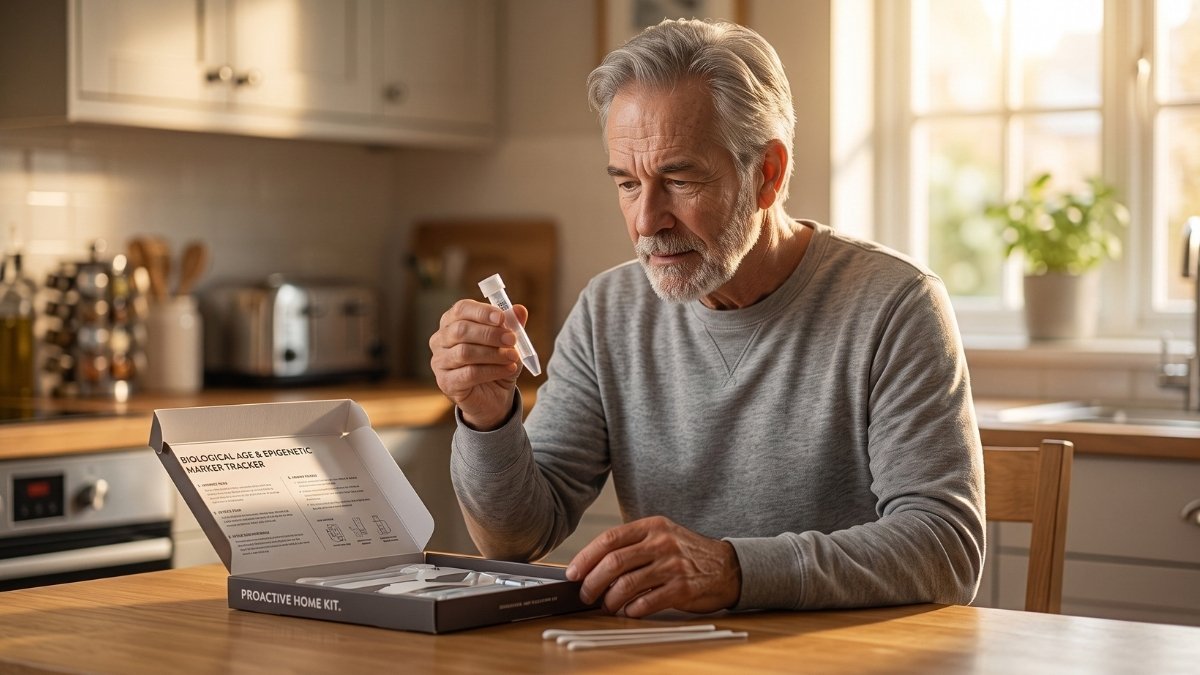
These tests are sold directly to consumers now, and results can shift over months based on diet, sleep, exercise, and stress levels. That gives a rough scorecard for whether daily changes are actually moving the needle, rather than just feeling like they should be.
They are not diagnostic tools, and they are not a replacement for the regular checkups and screening tests your own doctor already orders.
Try This Today
The Daily Habit Stack That Actually Works
- Push your first meal back two to three hours and notice how your energy holds up through the morning.
- Add one short, hard interval to your normal walk or workout. Even ninety seconds at a harder pace counts.
- Swap one meat based meal this week for lentils, beans, or a big serving of dark leafy greens.
- Set a fixed bedtime and a fixed wake time for seven days straight, weekends included.
- Cut back to one alcoholic drink or fewer for the next two weeks and pay attention to how sleep changes.
When To Loop In Your Doctor First

Several parts of Sinclair’s personal routine are not casual, general use supplements. Talk to a doctor before starting anything if any of the following apply to you.
- You already take medication for blood sugar, cholesterol, or blood pressure, since several longevity compounds can interact with these.
- You have kidney or liver disease, since how your body clears supplements can be affected.
- You are pregnant, breastfeeding, or planning to become pregnant.
- You notice new muscle pain, unusual bruising, or digestive changes after starting anything new on this list.
A Few Questions Worth Asking Before You Start
How long before you would notice anything? Sleep quality, energy, and workout recovery are usually the first things people report changing, often within a few weeks of consistent habit changes. Epigenetic clock results tend to move more slowly, typically over several months.
Does everyone need to take what Sinclair takes? No. His personal supplement choices reflect his own research interests and his own risk tolerance. Most of the proven longevity benefit still comes from the foundation layer, not the supplement layer.
Is any part of this risky? Some pieces carry real interactions and are not appropriate for everyone. That is exactly why a doctor conversation belongs before starting anything new, not after.
Who should be especially cautious? Anyone managing a chronic condition, anyone on multiple medications, and anyone pregnant or nursing should treat the supplement and medication related parts of this list as a conversation for their doctor rather than a shopping list.
What about the reprogramming research specifically? That piece is still confined to research trials, so for now it belongs in the “worth watching closely” category rather than the “something to try this month” category.
This article is for informational purposes only and is not a substitute for professional medical advice, diagnosis, or treatment. Always consult your doctor or a qualified healthcare provider before making changes to your diet, exercise routine, or medications, especially if you have an existing health condition.