

You wake up at 2am. Then again at 3:40am. Then once more before the alarm even has a chance to go off, and you tell yourself it is just what happens as you get older.
Here is the agitating part. Researchers studying the APOE4 gene, the strongest known genetic risk factor for Alzheimer’s disease, have found that broken up sleep does not just leave you tired the next day.
It is present in up to 60% of Alzheimer’s patients, and sleep impairment appears to be a causal contributor to the disease process itself, feeding into a two way relationship with the buildup of amyloid protein in the brain. Oxford Academic
Turns out there is a real difference between occasional restless nights and a pattern of fragmented sleep, and most people have never heard which one actually matters.
Before making any changes based on this article, talk to your doctor, especially if you are currently taking medication or have a diagnosed condition.
What “Waking Up Multiple Times” Actually Means For Your Brain
Not all interrupted sleep is equal. Waking once, rolling over, and drifting back off in two minutes is different from lying awake for twenty minutes, several times a night, night after night.
Researchers call this second pattern sleep fragmentation. It is the specific thing scientists have been studying in relation to Alzheimer’s risk, not the occasional bad night everyone has.

APOE4 is a gene variant, not a diagnosis. Carrying one copy raises Alzheimer’s risk. Carrying two copies raises it further. Research estimates that one copy of the APOE4 variant carries roughly three times the risk of Alzheimer’s compared to the more common form of the gene, while two copies carry roughly fourteen times the risk. Most people never get tested for this and never need to. nih
Why Waking Up Multiple Times At Night Keeps Showing Up In The Research
This is not a single study making a splash. It is a pattern that keeps surfacing across more than a decade of research.
A widely cited study out of Rush University tracked older adults for up to six years using wearable sensors that measured how broken up their sleep actually was, night after night.
Over that follow up period, higher sleep fragmentation was associated with a meaningfully increased risk of developing Alzheimer’s disease, even after accounting for age, sex, and education. Oxford Academic
The same research group then asked a sharper question. Does broken sleep matter more for people who already carry the APOE4 gene?
Among people with high levels of sleep fragmentation, those carrying two copies of APOE4 showed a rate of cognitive decline roughly 3.4 times faster than non carriers. Among people whose sleep was less fragmented, that same gap shrank to about 1.3 times, meaning the genetic risk had far less room to do damage. Neurology
That detail is the actual headline here. The gene alone does not decide the outcome. Sleep quality appears to change how much the gene matters.

Separate research backs this up from another angle. A study of nearly 200 dementia free adults over 55 found that APOE4 carriers had lower amounts and shorter stretches of REM sleep compared to non carriers, detectable even before any cognitive symptoms appeared.
Another study comparing Alzheimer’s patients by APOE4 status found carriers showed higher sleep fragmentation on wearable tracking than non carriers. nihnih
Everyone’s body responds differently, so check with your doctor before trying this if you have an existing condition or take medication.
What’s Actually Waking You Up
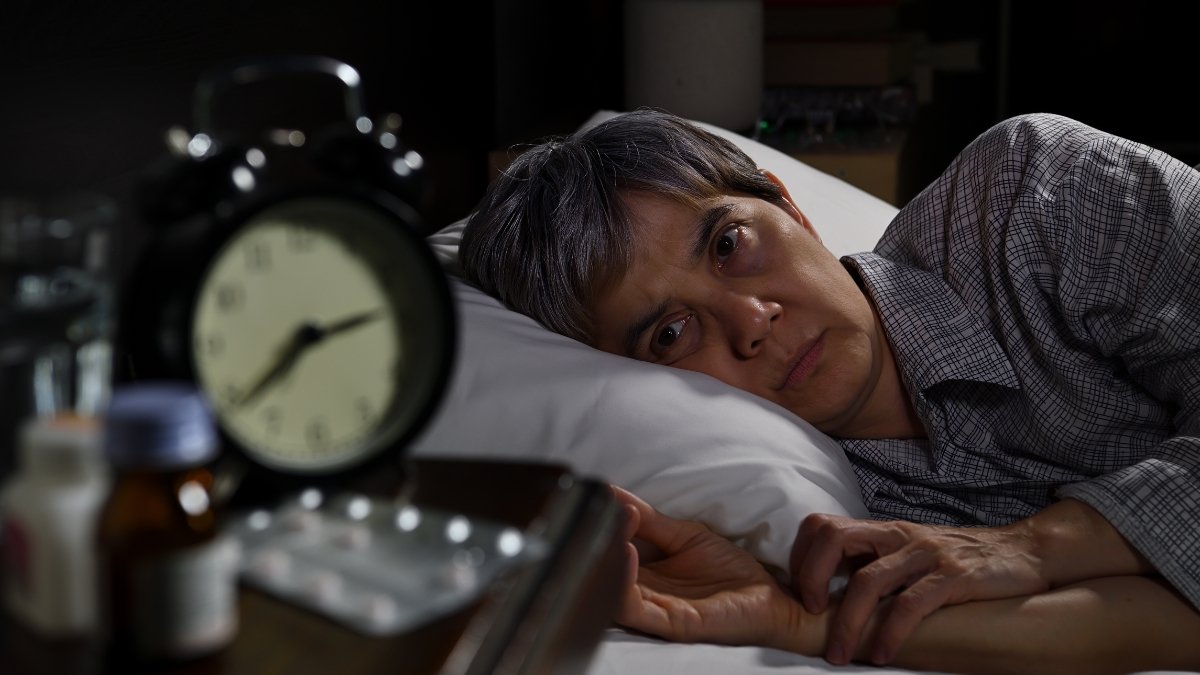
Before jumping to conclusions about genetics, it helps to rule out the far more common, and far more fixable, culprits behind broken sleep.
Nighttime Waking Diagnostics
Identify the root cause of your sleep disruptions and know when to seek help.
Nocturia (Urination)
Often ReversibleWaking up to use the bathroom, sometimes more than once. Can usually be fixed with fluid timing and treating root causes.
See A Doctor If: It consistently happens more than twice a night.
Sleep Apnea
Highly TreatableCharacterized by loud snoring, gasping, or waking up abruptly without an obvious reason. Highly responsive to CPAP treatment.
See A Doctor If: A partner notices explicit pauses in your breathing while asleep.
Restless Legs Syndrome
Often ReversibleAn uncontrollable urge to move the legs, which typically gets worse in the evening and interrupts the transition to deep sleep.
See A Doctor If: The urge to move happens most nights and prevents falling back asleep.
Chronic Pain (e.g. Arthritis)
ManageableWaking up sharply when shifting positions during the night, or when inflammation and pain suddenly flare up.
See A Doctor If: The pain is new, changing in nature, or getting progressively worse.
Heart or Lung Conditions
Condition DependentWaking up experiencing shortness of breath or literally gasping for air. This is a severe systemic warning sign.
CRITICAL ALERT: Seek medical attention right away. Do not wait for this to resolve on its own.
Nocturia in particular becomes far more common with age. By age 80, it affects somewhere between 80% and 90% of both men and women. Older research using overnight sleep monitoring found that the large majority of these bathroom triggered wake ups, close to 80%, were actually being caused by an underlying sleep disorder like sleep apnea or leg movements, not just an overactive bladder. clinicaltrialsPubMed
Why Deep Sleep Matters So Much
Here is the part almost nobody explains well. The brain has its own cleanup crew, called the glymphatic system, and it mostly clocks in once you reach deep, slow wave sleep.
This system works like a drainage network, flushing waste proteins, including amyloid beta and the tau protein linked to Alzheimer’s, out of brain tissue while you sleep. Deep sleep appears to be a prerequisite for this clearance process to work properly. American Nurse JournalScienceDirect
This is not just theory anymore. A 2026 human trial found that a full night of normal sleep, compared to sleep deprivation, produced a distinct overnight change in blood levels of amyloid and tau, consistent with the brain’s cleanup system doing more work during real, uninterrupted sleep. Nature
Animal research adds the genetic piece back in. Mice carrying the human APOE4 gene and subjected to disrupted sleep showed faster buildup of amyloid plaques and spreading of tau pathology compared to mice with the more common gene variant under the same sleep disruption.
The same research also found reduced activity of a protein called aquaporin 4, which normally helps the brain’s cleanup system do its job, in the APOE4 carrying, sleep deprived mice. PubMedJCI
In plain terms, breaking sleep into pieces seems to interrupt the brain’s nightly trash pickup, and that interruption appears to hit harder in people whose genetics already put them at higher baseline risk.
Deep Sleep Versus Fragmented Sleep: A Side By Side Look
The Cognitive Cost of Fragmentation
How broken sleep physically alters brain function and long-term health.
The Brain’s Cleanup System
Fluid moves through brain tissue optimally, clearing out waste, including amyloid and tau.
Clearance slows significantly since it depends on extended stretches of uninterrupted deep sleep.
Overnight Blood Markers
Biological patterns are highly consistent with normal, ongoing clearance and neural repair.
Altered and disrupted patterns, as explicitly confirmed by recent 2026 human trial data.
How You Feel The Next Day
Experience sharper recall, a noticeably steadier mood, and sustained natural energy.
Suffer from foggier thinking, irritability, and a heavy reliance on caffeine or daytime naps.
Pattern Over Years
Directly associated in clinical research with much steadier cognitive aging.
Strongly associated with a measurably higher long-term Alzheimer’s risk.
Try This Today

The Habit That Actually Helps
- Keep a simple log of every time you wake up tonight, even briefly. A week of honest tracking tells you far more than guessing.
- Cut caffeine after early afternoon and alcohol close to bedtime. Both can fragment sleep even if alcohol helps you fall asleep faster at first.
- Move your last large drink of water to at least two to three hours before lights out.
- If you share a bed, ask whether your partner has noticed snoring, gasping, or pauses in your breathing.
- Get outside for daylight or a short walk earlier in the day. It helps anchor your body’s internal sleep and wake rhythm.
When Waking Up At Night Means More Than Just Aging
When To See A Doctor
- Your partner notices loud snoring, choking sounds, or pauses in your breathing.
- You regularly wake up gasping or with chest discomfort.
- Nighttime waking is paired with new memory lapses, confusion, or getting lost somewhere familiar.
- You feel exhausted most days despite spending enough time in bed.
Evening Habits: What Helps, What Hurts

| Do This In The Evening | Skip This In The Evening |
|---|---|
| Stop drinks two to three hours before bed | Finishing a large glass of water right at bedtime |
| Keep the bedroom cool, dark, and quiet | Falling asleep with a bright screen or television on |
| Get outside light and some movement earlier in the day | Staying inactive all day and then wondering why sleep feels restless |
| Ask a doctor about loud snoring or gasping | Assuming loud snoring is harmless |
| Keep a consistent sleep and wake time, even on weekends | Sleeping in dramatically on weekends to “catch up” |
Common Questions

Does waking up at night mean I will get Alzheimer’s?
No. Research on sleep disturbance and dementia risk has actually produced mixed findings depending on the specific type of disruption, and trouble falling back asleep after waking was not consistently linked to higher risk in every study. One symptom is not a diagnosis. nih
How many times waking up counts as too many?
Researchers generally consider two or more nightly awakenings to urinate a meaningful threshold worth addressing, and that pattern affects close to a third of older adults. The same general idea applies to fragmented sleep overall: an occasional restless night is normal, a consistent nightly pattern is worth a conversation with a doctor. nih
Can improving my sleep actually lower my risk?
The Rush University findings suggest managing sleep fragmentation may help offset some of the risk tied to carrying the APOE4 gene, though researchers are still studying exactly how much benefit is possible and for whom.
Should I get genetic testing for APOE4?
That is a personal and medical decision, not something to decide from an article. A doctor or genetic counselor can walk through the pros, cons, and what the result would and would not tell you.
Final Thought,
Waking up during the night is common, especially with age, and most of the time it traces back to something fixable like fluid timing, undiagnosed sleep apnea, or an uncomfortable mattress, not a genetic sentence.

What the research keeps pointing to is that consistent, fragmented sleep deserves real attention rather than a shrug, particularly because the brain does genuine repair work during the deep sleep that gets lost when rest is constantly interrupted.
Waking up multiple times at night may be linked to Alzheimer’s genetic risk. Learn what the research shows and how to protect your sleep.