

Your muscles start losing size and strength around age 30. Not 60. Not 70. Thirty.
Most people think muscle loss happens later in life, after retirement, after the grandkids show up. That’s not true.
By your mid-30s, this process has already started. It moves quietly. You won’t notice at first.
Then one day the jar lid feels tighter, or the stairs feel steeper than they used to. The good news: you can slow this down, starting today.
This guide shows you exactly how much lean protein to eat, when to eat it, and which foods actually work. No guessing, no trends, just what current research says helps prevent sarcopenia before it becomes a real problem.
Point One: Why Sarcopenia Starts Long Before Age 60
You probably think muscle loss is an old person’s problem. It isn’t. Sarcopenia [age-related loss of muscle mass, strength, and physical function] begins far earlier than most people realize.

Muscle mass drops by about 3 to 8 percent per decade after age 30. That decline speeds up once you pass 60.
Researchers have measured clear drops in muscle mass, strength, and power starting at around age 35. Here’s why this matters if you’re 35, 45, or 55.
This isn’t a future problem. It’s happening now, in the background, while you live your normal life. The habits you build today shape how strong and independent you’ll be at 65 and beyond.
The fix starts with one change: eating enough of the right protein. The rest of this guide shows you how.
- Muscle loss starts at 30, not 60
- The decline speeds up after 60
- Small changes now protect your strength later
Point Two: The Protein Target That Beats the Standard RDA
If you’re eating the standard recommended amount of protein, you’re probably eating too little to protect your muscle. The official RDA is 0.8 grams per kilogram of body weight daily.
That number was built to prevent deficiency. It was not built to preserve muscle.
Research now points to a higher target: 1.0 to 1.2 grams per kilogram of body weight daily for healthy adults who want to protect their muscle as they age.
Here’s what that looks like in real numbers. If you weigh 70 kg, about 154 lbs, your target moves from 56 grams a day, the old RDA, to roughly 70 to 84 grams a day. That’s a real difference, not a small tweak.
One honest note: these numbers come mostly from research on adults over 60. If you’re younger, treat this as a solid starting point, not a strict rule. A doctor or dietitian can help you fine-tune it.
- Old RDA (0.8g/kg) prevents deficiency, not muscle loss
- New target: 1.0 to 1.2g/kg for prevention
- A 154 lb adult should aim for roughly 70 to 84g daily
Point Three: Spread Your Protein Out, Don’t Save It for Dinner
Most people eat protein backwards. A small amount at breakfast, a little more at lunch, then a huge portion at dinner.
This pattern wastes a lot of your effort. Here’s why.
Your body needs a minimum amount of a specific amino acid, called leucine [an amino acid that switches on muscle-building signals in the body], in one sitting to actually trigger muscle building. Below that amount, the signal barely fires.
If you eat 10 grams at breakfast, 15 at lunch, and 60 at dinner, you’ve hit 85 grams total for the day. But you’ve only switched on that muscle-building signal once, at dinner.
The other two meals did almost nothing for your muscle. The fix: aim for 25 to 40 grams of protein at each meal, 3 to 4 times a day.
Same total protein, spread out properly, works far better than one big dinner portion.
- Big dinner portions waste your daily protein
- Aim for 25 to 40g of protein per meal
- Spread protein across 3 to 4 meals, not one
Point Four: Lean Protein Foods That Hit Your Daily Target
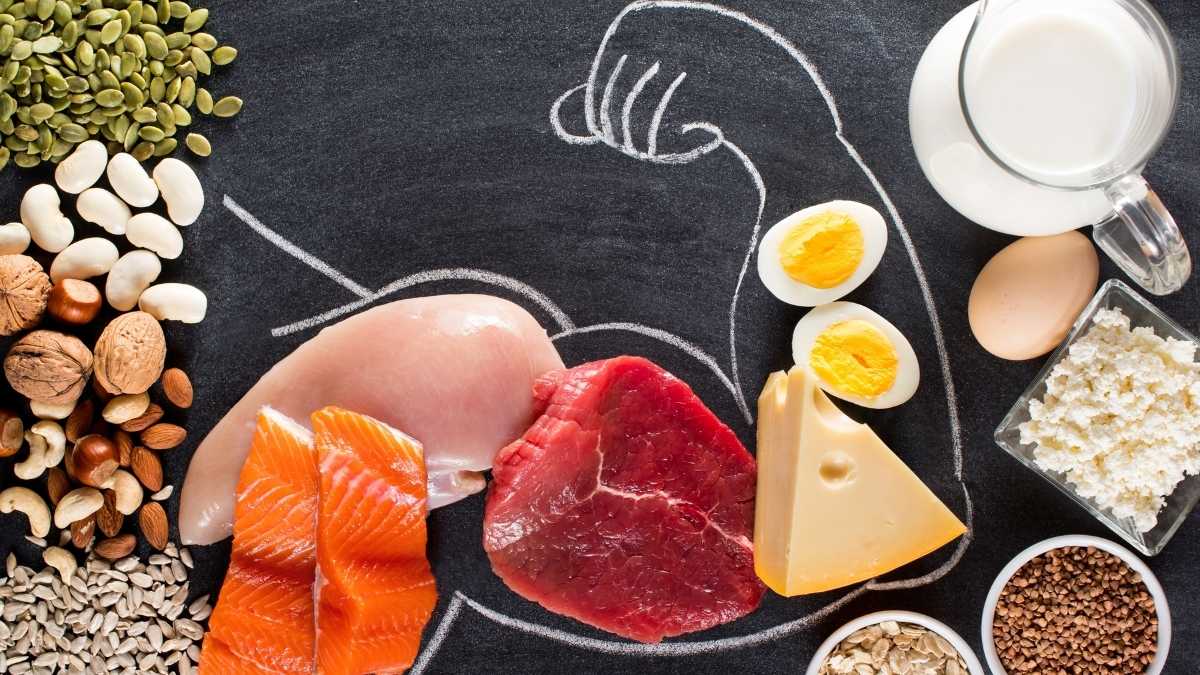
You don’t need fancy supplements to hit your protein target. Regular grocery store foods get you there.
Common Options
& Protein Content
Chicken breast
3 oz cooked
Canned tuna
100g
Greek yogurt
6 oz
Cottage cheese
Half cup
Eggs
1 large
One honest catch for plant-based eaters: plant proteins take a lot more volume to hit the same target. To get enough leucine from tofu alone, you’d need to eat close to three-quarters of a pound in one sitting.
That’s a lot of tofu for one meal. The fix isn’t to avoid plant protein. It’s to combine sources, like tofu with lentils and a scoop of protein powder, or simply eat larger plant-based portions than you’d expect.
- Animal proteins hit your target in smaller portions
- Plant proteins need bigger portions or combos
- Mix sources to keep meals realistic and varied
Point Five: Pair Protein With Resistance Movement for Real Results
Eating more protein without moving your muscles is like filling a car with gas and never driving it. The fuel just sits there.

Research backs this up clearly. One study found that protein combined with resistance training increased fat-free mass by 0.23 kg and skeletal muscle mass by 0.39 kg, compared to resistance training alone.
Protein works better when your muscles are actually being challenged. Dr. Stuart Phillips, a muscle researcher at McMaster University, puts it simply: the exercise does the heavy lifting, and protein just supports what the exercise already started.
You don’t need a gym membership. Bodyweight moves like squats, wall push-ups, and resistance bands count.
The goal is simple: challenge your muscles a few times a week, and let your protein intake support the repair work.
- Protein alone underperforms without movement
- Combining both boosts muscle mass more than either alone
- Bodyweight exercise at home counts, no gym required
Point Six: The Real Cost of Waiting to Prevent Sarcopenia
If you think sarcopenia is rare, it isn’t. It’s common, and it’s more likely affecting people around you than you’d guess.

Research shows sarcopenia affects between 10 and 27 percent of older adults, depending on how it’s measured.
Worldwide, over 50 million people are affected right now, and that number is projected to grow past 200 million over the next 40 years. Sarcopenia has also been linked to a much higher risk of fall-related fractures.
That connection matters because falls are one of the biggest threats to independence as people age. None of this is meant to scare you.
It’s meant to show you this is worth acting on now, while it’s still easy to influence. Waiting doesn’t make the fix simpler. It makes the starting point harder.
- Sarcopenia affects 10 to 27 percent of older adults
- Over 50 million people are affected worldwide today
- It’s linked to a higher risk of fall injuries
Point Seven: A Sample Day of Lean Protein to Prevent Muscle Loss
Here’s what a full day looks like when your protein is spread out correctly, using ordinary foods you can find anywhere.
- Breakfast: 3 eggs plus Greek yogurt, about 30 grams
- Lunch: Grilled chicken breast (6 oz) on a salad, about 35 grams
- Snack: Cottage cheese with fruit, about 15 grams
- Dinner: Baked salmon (4 oz) with vegetables, about 28 grams
That adds up to roughly 108 grams for the day, spread across four meals instead of stacked into one.
Each meal crosses the threshold needed to support muscle repair, instead of relying on one big dinner to do all the work. You don’t need to copy this exactly.
Swap in your own foods using the list from Point Four, and keep each meal in that 25 to 40 gram range.
- Spread protein across 4 meals, not 1 or 2
- Use ordinary foods, no special products needed
- Aim for 25 to 40g at each meal
Point Eight: Protein Mistakes That Work Against Preventing Sarcopenia

Even people who try hard on this often make small mistakes that cancel out their effort. One survey found that 88 percent of people don’t actually know how much protein they eat daily.
That’s the first mistake: guessing instead of checking. A second mistake is relying on protein bars and shakes instead of whole foods, which often deliver less real nutrition than the label suggests.
Skipping protein at breakfast is another big one. Coffee and toast gives you almost none, which wastes your first chance of the day to trigger muscle repair.
And finally, some people focus only on protein and skip movement entirely, missing the exercise half of this equation from Point Five. Fixing these four habits matters more than any single perfect food choice.
- Track your actual protein intake for a few days
- Choose whole foods over bars and shakes most of the time
- Add protein to breakfast, don’t skip it
Final Words,
Muscle loss starts earlier than most people realize, but the fix is simple: eat enough protein, spread it across your day, and pair it with movement. Start small. Pick one meal today and add 25 to 30 grams of protein to it. That’s how you prevent sarcopenia before it starts.