

Your muscles are not dying of old age. They are dying of neglect. And 2025 science now proves you can reverse that — at any age.
Most people over 60 feel weaker, move slower, and worry about losing independence. Many try “senior exercises” but see no real change. That happens because those programs are too gentle to trigger actual muscle growth.
This guide gives you the real answer. You will learn which exercises rebuild muscle, how often to train, how much protein to eat, and how recovery works differently after 60.
You will also see what researchers at Duke-NUS Medical School found about how exercise rewires aging muscle at the cellular level.
Explore Exercises to Rebuild Muscle & Healthy Aging
Read them one by one to discover the specific routines researchers say can help you stay strong and vibrant.
No complicated plans. No fluff. Just simple, proven steps that work — whether you are 55 or 85.
Point One — Why Your Muscles Are Shrinking (And Why It Is Not Your Fault)
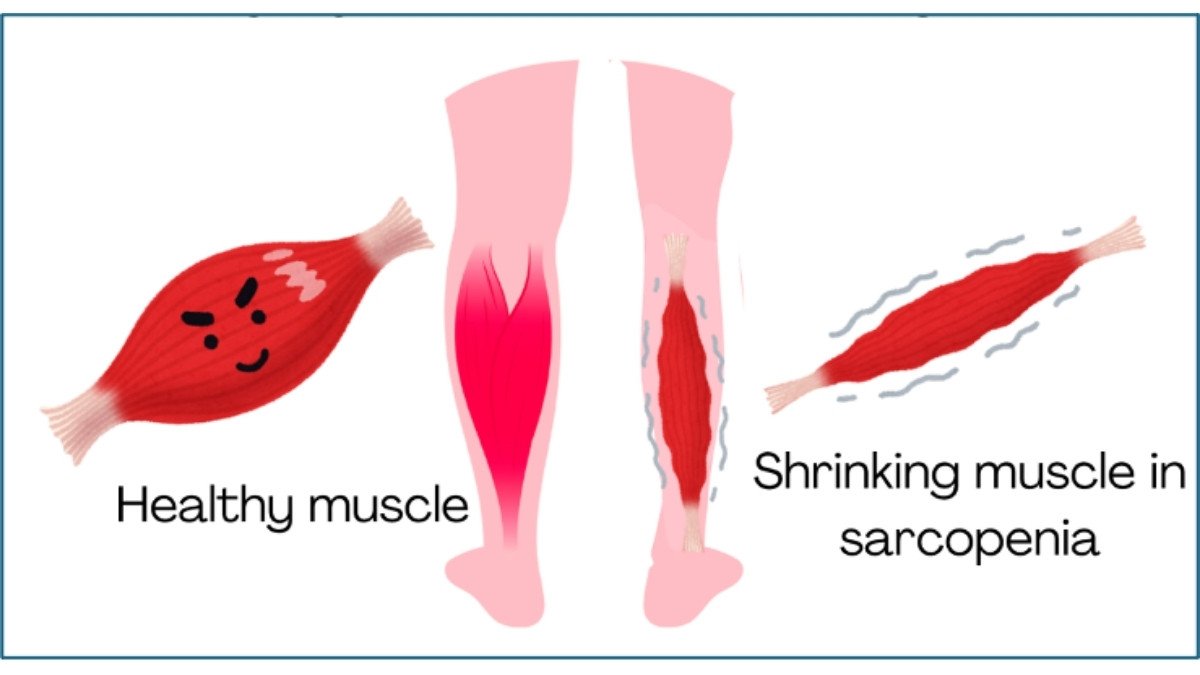
There is a medical name for this: sarcopenia. It means the slow loss of muscle mass, strength, and function. The CDC officially classified it as a disease in 2016. This is not weakness of character. It is biology.
After age 30, adults lose 3% to 8% of muscle per decade. After 60, that loss speeds up fast. Sarcopenia affects 5% to 13% of people aged 60 and older — and up to 50% of people over 80.
Here is why it happens. Your hormones drop. Testosterone and IGF-1 both decline with age. Your muscles also develop anabolic resistance — meaning they need almost twice the protein to trigger growth compared to younger muscles.
The consequences go beyond feeling weak. Sarcopenia raises your fall risk, slows your metabolism, lowers bone density, and raises your risk of type 2 diabetes. Muscle burns calories at rest and regulates blood sugar every single day.
3 Quick Tips:
- Ask your doctor to check your muscle function at your next visit — early detection matters
- Track how easily you rise from a chair without using your arms — this is a real sarcopenia warning sign
- Do not accept weakness as normal — it is a condition, and conditions can be treated
Point Two — The 2025 Science Breakthrough That Changes Everything

In November 2025, scientists at Duke-NUS Medical School published a major finding in the Proceedings of the National Academy of Sciences. They found that aging muscles have a molecular switch called the mTORC1 pathway. With age, this switch gets stuck in the “on” position.
When mTORC1 stays overactive, damaged proteins pile up inside muscle cells. The muscle cannot repair itself properly. This is a key reason aging muscles shrink faster and heal slower.
Here is what changes everything. Exercise activates proteins that lower a molecule called DEAF1. When DEAF1 drops, the mTORC1 pathway rebalances. The muscle clears out damage and rebuilds properly again. Researcher Priscillia Choy described it simply — exercise acts like a rewind button for aging muscle biology.
One honest caveat: if DEAF1 levels are extremely high, exercise alone may not fully restore repair. That is exactly why pairing exercise with proper nutrition is not optional — it is required.
3 Quick Tips:
- Share this research with your doctor — it supports the case for prescribed exercise in older adults
- Remember that exercise works at the cellular level, not just at the surface — this gives it real power
- Pair every workout with a protein-rich meal within 2 hours to support the repair process your muscles just started
Point Three — Progressive Overload Is the Only Rule That Matters
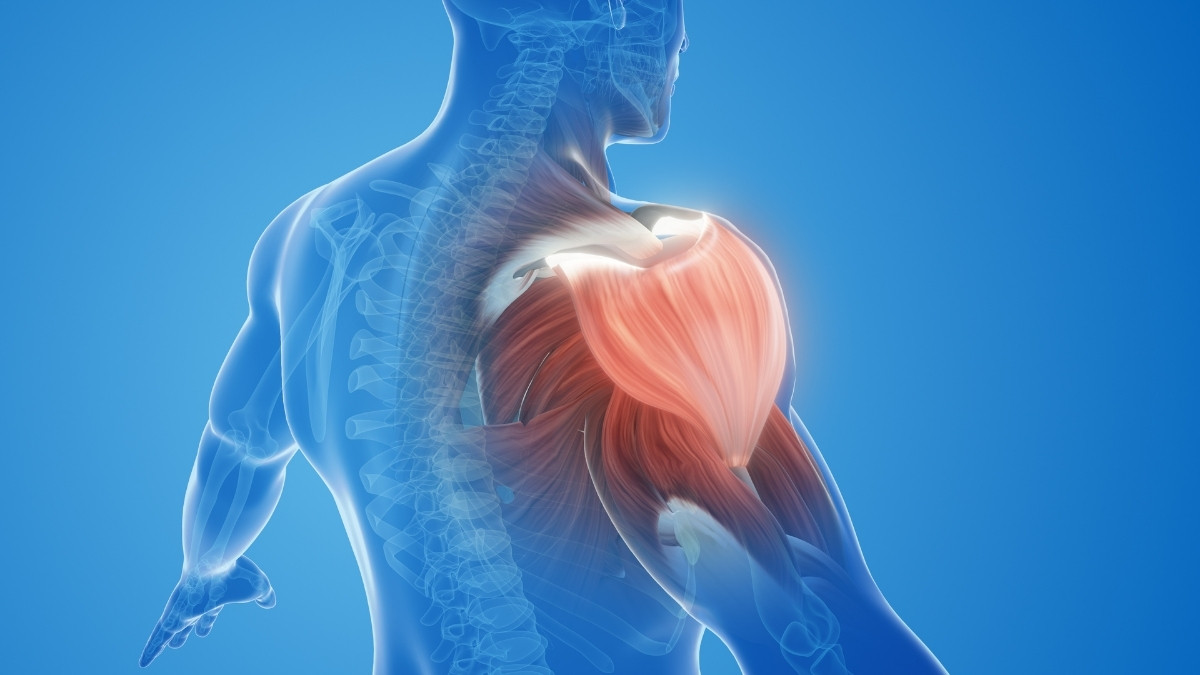
Most senior fitness programs fail for one reason. They are too easy.
Progressive overload means giving your muscles a challenge they have not fully adapted to — then making it slightly harder over time. Without that challenge, your muscles have no reason to grow. They only grow when they must.
Gentle chair exercises and light walking are fine for circulation. But they do not provide enough resistance to reverse sarcopenia. Think of it this way: if carrying one grocery bag feels easy every day, your arms will never get stronger from it.
You do not need a gym to apply this. Add more reps each week. Slow the lowering phase of each movement to 3 or 4 seconds. Use resistance bands and move to a thicker one over time.
Research from the University of Michigan found that after 18 to 20 weeks of progressive resistance training, adults gained an average of 2.42 pounds of lean muscle and increased strength by 25% to 30%.
3 Quick Tips:
- Write down your reps and sets after every session — if numbers are not going up, progress has stopped
- Slow your lowering phase to 4 seconds on every exercise — this simple change doubles muscle stimulus
- Move to a thicker resistance band the moment your current one feels easy for all 3 sets
Point Four — The Exact Exercises That Rebuild Muscle After 60
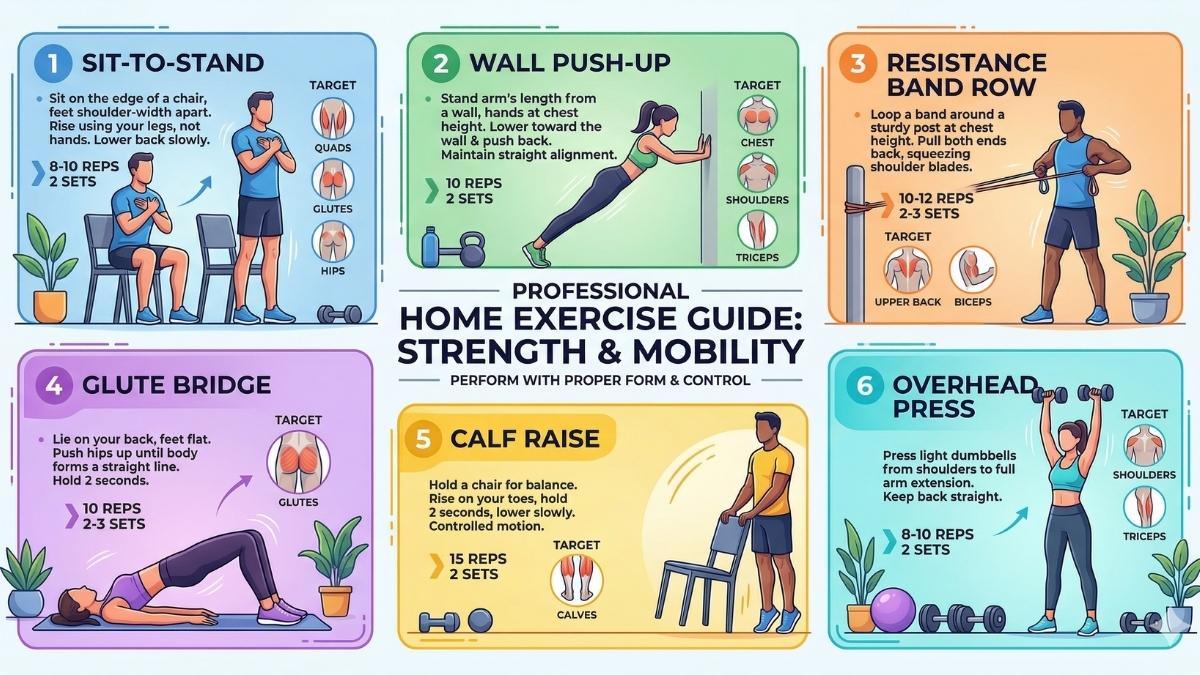
Always start with bodyweight or the lightest resistance. Build the movement pattern first. Add load second. Your joints will thank you.
The Foundation Six
Sit at the edge of a chair, feet shoulder-width apart. Rise using your legs, not your hands. Lower back slowly.
Stand arm’s length from a wall, hands at chest height. Lower toward the wall and push back.
Loop a band around a sturdy post at chest height. Pull both ends back, squeezing your shoulder blades.
Lie on your back, feet flat. Push hips up until your body forms a straight line. Hold for 2 seconds.
Hold a chair for balance. Rise on your toes, hold 2 seconds, lower slowly to the starting position.
Press light dumbbells (or household objects) from your shoulders to full arm extension above your head.
3 Quick Tips:
- Film yourself with your phone to check form — bad form causes injury, good form causes results
- Focus on lower body exercises first — they use the largest muscles and protect your independence the most
- Rest 60 to 90 seconds between sets — long enough to recover, short enough to keep the session effective
Point Five — The Protein Strategy That Makes Exercise Actually Work

Exercise creates the signal. Protein provides the materials. Without enough protein, your body cannot build new muscle tissue — no matter how hard you train.
Older adults need more protein than younger adults. Research recommends 1.2 to 1.6 grams of protein per kilogram of body weight daily. For a 150-pound person, that is roughly 80 to 110 grams per day.
Spreading protein across meals matters as much as the total amount. Aim for 25 to 30 grams per meal. This triggers muscle protein synthesis throughout the day. Eating it all at dinner does not work the same way.
The amino acid leucine is the key trigger for muscle building. Foods highest in leucine include eggs, chicken, beef, whey protein, and soybeans.
A simple daily plan: Breakfast — 3 eggs and Greek yogurt (30g protein). Lunch — canned tuna with bread and salad (30g protein). Dinner — chicken with lentils and vegetables (35g protein). That hits roughly 95 grams total.
3 Quick Tips:
- Add Greek yogurt or cottage cheese to any snack — both are cheap, easy, and high in leucine
- Never skip breakfast protein — your muscles go through repair overnight and need fuel in the morning
- If appetite is low, try a whey protein shake — it digests easily and delivers leucine fast
Point Six — Recovery, Sleep, and the Habits That Multiply Your Results
Muscles do not grow during the workout. They grow during rest. The workout creates the signal. Rest is when your body actually rebuilds. Skipping recovery is the most common mistake older adults make.
Allow at least 48 hours between sessions that work the same muscles. A Monday-Thursday or Tuesday-Friday schedule works well for most people starting out.
Sleep is your most powerful recovery tool. Aim for 7 to 9 hours per night. During deep sleep, your body releases growth hormone — the same hormone that drives muscle repair. Sleeping under 6 hours actively accelerates muscle loss.
Anti-inflammatory eating habits help too. Cut back on ultra-processed foods, excess sugar, and refined oils. These all promote inflammation that slows muscle repair. Eat colorful vegetables, berries, olive oil, fatty fish, and turmeric regularly.
Two supplements have strong evidence for older adults. Vitamin D deficiency is common after 60 and directly weakens muscle function. Creatine monohydrate at 3 to 5 grams per day enhances strength gains from resistance training in multiple studies.
3 Quick Tips:
- Set a consistent bedtime and wake time — irregular sleep disrupts growth hormone release
- Take 1,000 to 2,000 IU of Vitamin D daily if you are not getting regular sun exposure — check with your doctor first
- Add creatine monohydrate to your morning water or protein shake — it is inexpensive, safe, and backed by decades of research
Point Seven — How to Progress Safely and Avoid the Most Common Mistakes

Mistake One — Starting too hard. Jumping into heavy weights before your body is ready causes injury. That ends your program fast. Spend the first 2 to 3 weeks with light resistance and focus only on correct movement.
Mistake Two — Never increasing the challenge. If a routine feels easy after several weeks and nothing is changing, your muscles have adapted and stopped growing. Progression is not optional — it is the whole point.
Mistake Three — Ignoring pain signals. Muscle fatigue is expected. Sharp joint pain, swelling, or pain lasting more than 24 hours after exercise is not normal. Stop and see a doctor or physical therapist.
Use the 2-for-2 rule to know when to progress. When you can do 2 extra reps beyond your target for 2 workouts in a row — increase resistance or difficulty.
Always warm up for 5 minutes before each session. March in place, do arm circles, move slowly. Consider working with a certified trainer once a month to keep your technique correct.
3 Quick Tips:
- Use the 2-for-2 rule every session — write it in your workout log and act on it without delay
- If something hurts sharply, stop immediately — pain is information, not weakness
- Spend your first 3 weeks on form only — perfect movement prevents months of injury setbacks later
Point Eight — Your 4-Week Starter Plan: One Step at a Time

No gym needed. Just space to move and optional resistance bands.
Weeks 1 and 2 — Foundation Phase: Monday: Sit-to-Stand (2×8), Wall Push-Up (2×8), Calf Raise (2×12). Walk 15 minutes. Wednesday: Rest or a gentle 20-minute walk. Thursday: Band Row (2×10), Glute Bridge (2×10), Overhead Press (2×8). Saturday and Sunday: Rest or walking.
Weeks 3 and 4 — Build Phase: Increase all exercises to 3 sets. Slow the lowering phase of every movement to 3 or 4 seconds — this is where most muscle growth happens. If bodyweight feels easy, add light dumbbells or a thicker band. Add 2 reps to any exercise that felt manageable.
You may feel stronger within 2 to 4 weeks. That is your brain getting better at firing your muscles — real strength, even before visible size change. Visible muscle changes take 6 to 12 weeks of consistent work.
Check with your doctor before starting if you have osteoporosis, heart disease, joint replacements, or diabetes.
3 Quick Tips:
- Print this plan and stick it on your fridge — out of sight means out of routine
- Do not skip Thursday — upper body strength protects your shoulders, spine, and posture as much as legs
- After Week 4, repeat the plan with 1 extra set per exercise — that is your Week 5 progression already sorted
Final Thoughts:

Muscle loss is real. It starts early. And it is reversible.
The formula is not complicated: resistance training 2 to 3 times per week, enough protein spread across meals, 7 to 9 hours of sleep, and steady progression every week.
Pick one exercise from Point Four today. Do two sets. That is how it starts.
Rebuild muscle at any age with proven exercises. Science-backed plan for adults 60+ to fight muscle loss, boost strength, and stay independent.