
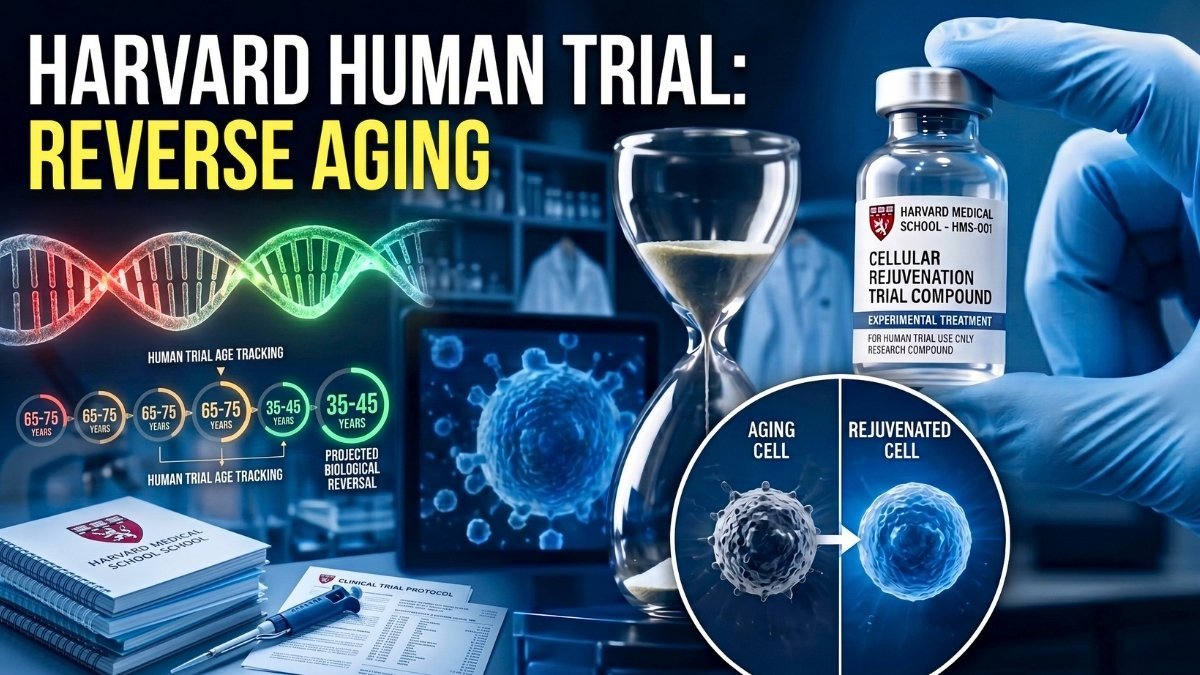
Right now, connected to a genetics lab at Harvard Medical School, a small group of patients has become among the first humans ever injected with a therapy built to reverse cellular aging inside a living body.
For most of medical history, that sentence would have been science fiction. Aging was something you could slow down with good habits, never something you could undo.
Millions of people are currently losing their vision to age related eye damage that doctors have long treated as permanent. This trial is the first real test of whether that has to stay true. The early details are already forcing longevity researchers to rethink what counts as possible.
Before making any changes based on this article, talk to your doctor, especially if you are currently taking medication or have a diagnosed eye condition.
What Actually Just Happened (And What Harvard Has To Do With It)
The trial was not launched by Harvard University as an institution. It comes out of a biotech company called Life Biosciences, cofounded by David Sinclair, a genetics professor at Harvard Medical School’s Blavatnik Institute who has spent years researching why cells age.

In January 2026, the FDA cleared Life Biosciences to begin the first human trial of a therapy called ER-100. By mid-2026, the first patient had received the injection.
This is a real, regulated Phase 1 clinical trial, not a wellness product or a supplement line. That distinction matters, because it separates this from most of what gets marketed under the “anti aging” label.
The Science Behind Reversing Cellular Aging
The therapy is built on something called partial cellular reprogramming, based on Nobel Prize winning research by Japanese scientist Shinya Yamanaka. Yamanaka discovered that a small set of proteins can push mature, aged cells back toward a younger biological state without turning them into an entirely different kind of cell.

Sinclair’s research group has framed this as an “information theory of aging.” The idea is that aging is not caused by the DNA itself being damaged beyond repair. Instead, cells slowly lose the correct instructions for reading that DNA, similar to how a scratched CD still holds the original recording even though the scratches make it skip.
Restore the readable instructions, the theory goes, and the cell can start acting younger again.
How The Therapy Actually Works
The treatment uses a modified virus, injected once directly into the eye, carrying genetic instructions for three of the four Yamanaka reprogramming factors.
Those genes stay switched off inside the patient’s cells until the person takes an oral dose of doxycycline, a common antibiotic that acts as the “on switch.” Once activated, the therapy is designed to partially reset the epigenetic markers in damaged optic nerve cells, nudging them back toward a more youthful, functional state.
The goal is not to erase what kind of cell it is. It is to restore function without wiping out identity.
The ER-100 Clinical Trial
A breakdown of the groundbreaking clinical trial aiming to reverse vision loss through cellular epigenetic reprogramming.
Life Biosciences
Cofounded by Harvard geneticist David Sinclair, focusing on the biology of aging.
ER-100
An epigenetic reprogramming therapy designed to restore youthful gene expression.
Eye Injection + Pill
A single injection administered into the eye, which is later activated by an oral antibiotic.
Glaucoma & NAION
Targeting optical diseases, including NAION, which causes sudden and permanent vision loss.
Phase 1 (Safety)
The primary goal of this phase is to establish safety and tolerability, not proven effectiveness yet.
~12 Patients
A highly controlled, small-scale initial group, roughly consisting of a dozen selected patients.
Why The Eye Came First
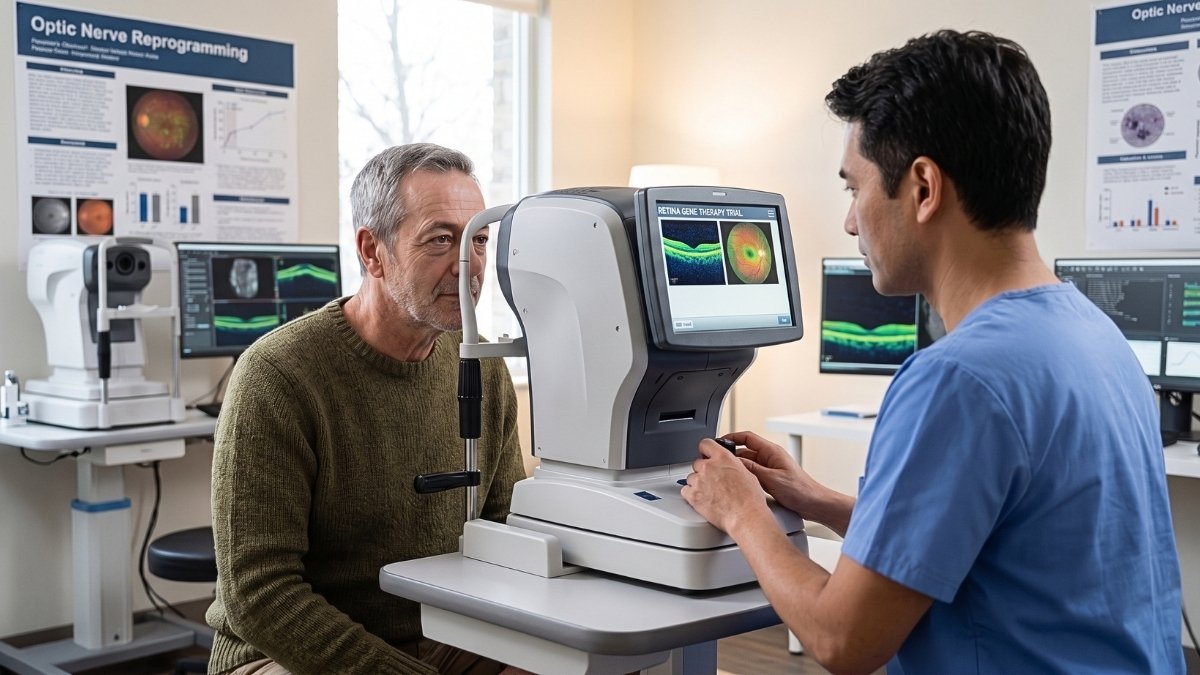
Researchers did not pick eye disease at random. The eye is one of the few places in the body where doctors can inject a therapy directly, watch the tissue in real time, and measure results without invasive surgery.
The trial is enrolling patients with glaucoma and a condition called NAION, which causes sudden, often permanent vision loss when blood flow to the optic nerve is disrupted. Both conditions involve optic nerve cells that gradually lose function with age, making them a logical first test site for this kind of therapy.
Everyone’s body responds differently, so check with your doctor before assuming any of these figures or timelines apply to your own health situation.
The Cancer Risk Nobody’s Headline Mentions
Here is the detail most coverage skips past. There are actually four Yamanaka factors, often shortened to OSKM. The fourth one, called c-Myc, is the most powerful at fully reprogramming a cell, and it is also the one most strongly linked to cancer risk in lab studies.

When cells are exposed to all four factors for too long, they can revert so completely that they forget what kind of cell they are supposed to be, which is exactly the process that can trigger tumor growth.
That is why ER-100 deliberately leaves c-Myc out and uses only the other three factors, known as OSK. It is also the main reason this is a small, slow, safety focused Phase 1 trial instead of a treatment doctors can already prescribe. Researchers need to confirm the therapy stays in that narrow, safe window before testing it more broadly.
Try This Today: Habits That Support Eye and Cellular Aging While The Science Catches Up
- Get blood pressure and blood sugar checked regularly. Both are established risk factors for the exact type of optic nerve damage this trial targets.
- Book a dilated eye exam at least once a year after age 40, since glaucoma often causes no symptoms until damage is already done.
- If you snore heavily or wake up gasping, ask a doctor about sleep apnea screening, since it is linked to higher NAION risk.
- Avoid smoking, which restricts blood flow to the small vessels feeding the optic nerve.
- Keep cholesterol in a healthy range, since narrowed blood vessels are a shared risk factor across several eye conditions.
How This Compares To Typical Anti Aging Claims
Most things marketed as “reversing aging” are supplements, skincare, or lifestyle products with no regulatory review behind them. This trial is a different category entirely.
Anti-Aging: Marketing vs. Medicine
Comparing the loosely regulated consumer supplement industry with the rigorous, highly controlled reality of the ER-100 clinical trial.
What’s Being Sold / Tested
Consumer pills, topical creams, and daily dietary powders.
A highly complex, single gene therapy injection.
Regulatory Oversight
Often none required before products hit the consumer market.
Strictly FDA cleared and heavily monitored clinical trial.
Evidence in Humans
Usually thin, largely anecdotal, or entirely absent.
Just beginning; currently in the rigorous safety/toxicity stage only.
Public Availability
Yes, immediately available for purchase online or in stores.
No, strictly limited to a carefully selected, small patient group.
Targeted Claims
Broad promises regarding “general aging,” energy boosts, and skin youth.
Testing against two very specific, measurable eye conditions, for now.
When To See A Doctor: Warning Signs Tied To This Trial’s Target Conditions
- Sudden, painless vision loss in one eye, especially if you notice it right after waking up
- Blurring or cloudiness that shows up in part of your field of vision rather than all of it
- Gradual loss of side (peripheral) vision that creeps in slowly, a classic early sign of glaucoma
- Sudden eye pain with blurred vision and halos around lights, which can signal an eye emergency
If any of these happen, this is not a wait and see situation. Contact an eye doctor or go to urgent care the same day.
Questions People Are Already Asking
Can I sign up for this trial? Not casually. Phase 1 trials like this one enroll a small, specific group of patients through clinical trial sites, and it is not open public enrollment. Anyone seriously interested should ask their eye doctor about listings on official clinical trial registries.
When could this actually reach regular patients? Historically, the path from a first human safety trial to an approved, available therapy takes roughly 8 to 12 years for a genuinely new type of treatment. This trial alone will not shortcut that timeline.
Does this prove aging itself can be reversed? Not yet, and not broadly. So far the therapy has only been tested in optic nerve tissue in the eye. It does not currently establish that this approach works elsewhere in the body, or that it extends lifespan.
Is this connected to supplements like NMN or resveratrol? No. Those are separate products sold directly to consumers with far weaker human evidence behind them. This trial is a regulated gene therapy, which is a completely different category of science and oversight.
The Bottom Line,
This trial does not mean anyone can reverse aging today. What it does mean is that, for the first time, the idea has moved out of mice and into a monitored human safety study, with real institutional backing behind it.
That is a genuinely significant first step. It is also just a first step, with years of testing still ahead before anyone knows how far this approach can actually go.
This article is for informational purposes only and is not a substitute for professional medical advice, diagnosis, or treatment. Always consult your doctor or a qualified healthcare provider before making changes to your diet, exercise routine, or medications, especially if you have an existing health condition.