Circadian Rhythm Hacking: The 3-Step “Light Sequence” to Boost Metabolism & Mood

You spend 90% of your time under artificial light that’s 100 times dimmer than daylight and 100 times brighter than moonlight—and it’s destroying your metabolism.
Despite eating well and exercising, you feel tired. You struggle with weight. You crash in the afternoon. You can’t sleep. Your circadian rhythm is broken from modern indoor living.
Here’s the fix: a free, science-backed 3-step light sequence. It takes 30 minutes daily. It resets your circadian rhythm, improves glucose control, boosts mood hormones, and increases your metabolic rate.
This comes from 2024-2025 research by the American Heart Association, National Institutes of Health, and 248 circadian scientists. No pills. No expensive gear. Just light exposure at the right times.
Let’s fix your metabolism.
Circadian Hack
This article is structured into 7 points—read them one by one to learn how a 3-step light sequence can hack your circadian rhythm to boost metabolism and mood.
1. The Science: Why Light Controls Your Metabolism
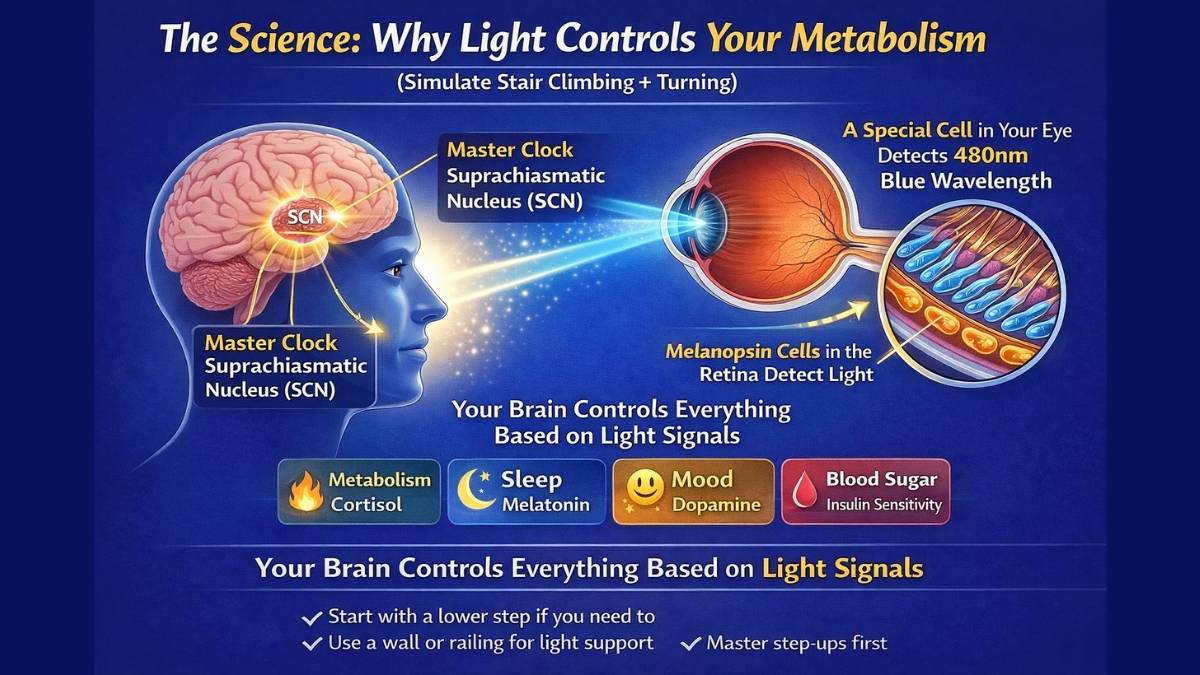
Your brain has a master clock called the suprachiasmatic nucleus (SCN). Special cells in your eyes—melanopsin cells—detect light at 480nm blue wavelength. They tell your SCN what time it is.
Your SCN controls everything. Cortisol for metabolism. Melatonin for sleep. Dopamine for mood. Insulin sensitivity for blood sugar. Light exposure timing runs the whole show.
Here’s the problem: indoor light is 100 times dimmer during the day and 100 times brighter at night than natural patterns. We spend 90% of our time indoors. Your body thinks it’s stuck in permanent twilight.
A 2024 PNAS study tracked 88,000+ people. Brighter nights and darker days predicted higher death risk. The American Heart Association’s 2024 statement says circadian disruption increases obesity, type 2 diabetes, and high blood pressure.
Natural daylight exposure improved blood glucose stability in type 2 diabetes patients, according to Cell Metabolism research. Morning light at 3,000 lux increased glucose tolerance and reduced anxiety.
Your metabolism needs the right light signals. Here’s how to send them.
2. Step 1 – Morning Light Anchor (Within 30-60 Minutes of Waking)

Get outside within 30-60 minutes of waking. Before 9 AM is best. This is non-negotiable for circadian clock setting.
Duration depends on weather. Sunny day: 5-10 minutes. Cloudy: 15-20 minutes. Overcast: 20-30 minutes. Just get out there.
Why it works: morning sunlight exposure sets a 16-hour timer for melatonin release. It spikes cortisol in a healthy way. This cortisol optimization boosts your metabolism and sharpens your focus.
You must go outside. Windows filter 50% of the wavelengths you need. Indoor lights give you 300-500 lux. Outside gives you 10,000-100,000 lux. That’s a massive difference.
Don’t wear sunglasses. Don’t wear blue blockers. Regular glasses and contacts are fine. Face the general direction of the sun—don’t stare at it. Walk around. Drink your coffee. Just be outside.
Huberman Lab calls this outdoor light therapy protocol non-negotiable 360 days per year. Indoor rooms measure 370 lux. Step outside? 3,000-9,000 lux minimum.
YOUR MORNING LIGHT PROTOCOL:
- Wake up time: _______
- Get outside by: _______ (add 30-60 min)
- Weather today: Sunny / Cloudy / Overcast
- Duration needed: 5-10 / 15-20 / 20-30 minutes
- Remove sunglasses ✓
- Face general direction of sun (don’t stare) ✓
- Can walk, sit, drink coffee—just be outside ✓
3. Step 2 – Afternoon Power Boost (12 PM – 4 PM Window)

Afternoon sunlight on your skin triggers something different than morning light. It activates the p53 pathway in your skin cells. This creates a hormone boost through your pituitary-hypothalamus axis.
Get 20-30 minutes of skin exposure 2-3 times per week. Studies show this increases testosterone by 29%, boosts estrogen, and improves mood and libido in both men and women. UVB exposure is the key.
Wear shorts and a t-shirt. Expose your arms and legs. You don’t need to sunbathe. Normal outdoor activity counts—walking, gardening, reading outside.
Afternoon sunlight benefits your eyes too. It adjusts eye sensitivity and buffers damage from evening artificial light. Late afternoon gives you yellow and orange wavelengths that signal “evening approaching” to your body.
Men’s testosterone peaks in summer and drops in winter. This correlates directly with sun exposure. The research is clear on testosterone optimization through afternoon light.
Afternoon viewing also helps with the circadian dead zone. Light at noon can’t properly set cortisol timing, but 2-4 PM light does the job.
YOUR AFTERNOON PROTOCOL:
- Best time window: 2-4 PM
- Get outside in shorts/short sleeves
- 20-30 minutes minimum
- Frequency: 2-3 times per week
- Combine with: walking, gardening, reading
- Don’t sunburn—this is moderate exposure
4. Step 3 – Evening Wind-Down (3 Hours Before Bed)

Blue light wavelengths (460-495nm) suppress melatonin production for 2+ hours. They delay your circadian phase. This kills your sleep and messes up your metabolism.
248 scientists agree: evening light exposure should have minimal blue content. This is scientific consensus on blue light blocking.
Start 3 hours before bed. If you sleep at 11 PM, start at 8 PM. Turn off overhead lights. Use table lamps and floor lamps only. Position lights at or below eye level. Dim your screens to 30-50% brightness.
Red light at 631nm is different. A 2025 study showed blue light at 9 PM kept melatonin suppressed at 7.5 pg/mL. Red light allowed melatonin production to recover to 26.0 pg/mL after 2 hours.
Light exposure during sleep impairs cardiometabolic function and blood glucose regulation, according to PNAS research. Bright light between 10 PM and 4 AM suppresses dopamine. This causes learning problems, mood issues, and blood sugar problems.
Keep your bedroom dark. Under 1 lux is ideal. Use nightlights in the bathroom instead of bright overhead lights.
YOUR EVENING PROTOCOL (3 hours before bed): If bedtime is 11 PM, start at 8 PM:
- Turn off overhead lights
- Use table lamps, floor lamps only
- Position lights at or below eye level
- Dim screens to 30-50% brightness
- Use red/amber bulbs if possible
- Keep bedroom dark as possible (<1 lux)
- Avoid bathroom bright lights—use nightlight
5. What the Research Shows: Metabolic Benefits

Natural light exposure improved blood glucose stability in type 2 diabetes patients. This comes from University of Geneva research in 2024. The metabolic health benefits are measurable.
The American Heart Association’s 2024 statement confirms proper light timing reduces obesity, diabetes, and high blood pressure risk. Circadian health influences metabolism, vascular function, and heart performance.
Morning bright light therapy shows promise for people with insulin resistance. Circadian misalignment strongly links to metabolic syndrome and weight gain. The blood glucose regulation improvements happen within weeks.
A 2024 study of 88,000+ people found proper light patterns reduced premature death risk. Obesity Reviews 2024 shows a strong link between social jetlag and obesity. The WHO IARC classifies shift work with circadian disruption as a probable cancer risk.
Your metabolism runs on circadian rhythms. Fix the light signals, fix the metabolism. The research proves this works for insulin sensitivity and weight management.
This isn’t theoretical. Real people get real results when they follow these light exposure protocols.
6. Mood & Mental Health Improvements

Morning sunlight increases dopamine levels. This improves your motivation and mood immediately. Dopamine optimization through light is one of the top 5 actions for mental health, according to Huberman Lab.
Bright light therapy treats seasonal affective disorder and major depression. This is established medical treatment, not alternative medicine. Studies show 3,000 lux morning exposure reduced anxiety and depression-like behavior.
Light activates those melanopsin cells in your eyes. They signal brain regions that control mood directly. You feel the mood enhancement within days.
A Nature Mental Health 2023 study of 85,000+ people linked day and night light exposure patterns to psychiatric disorders. Get it right, and mental health improves. Get it wrong, and you struggle.
Sexual satisfaction scores jumped from 2 to 6 on a 10-point scale with bright light treatment. The mental health benefits extend to every area of life.
Light therapy for depression works. Now you know exactly when to get it, how much you need, and why it fixes your mood.
7. Common Mistakes & How to Avoid Them

Mistake 1: Getting morning light through windows. Windows reduce light intensity 4-6 times. You get 1,400 lux instead of 9,000 lux. Go outside.
Mistake 2: Wearing sunglasses during morning exposure. You need that blue light to hit your eyes. Take them off for 10 minutes.
Mistake 3: Only getting light at midday. Noon is the circadian dead zone. Light at noon can’t set your cortisol timing properly. You need morning and afternoon light.
Mistake 4: Relying on indoor lights. They’re 100 times too dim. Indoor bright lights can’t turn on your cortisol mechanism. But those same lights disrupt sleep at night. It’s an asymmetry problem.
Mistake 5: Wearing blue blockers all day or sleeping with lights on. You need blue light in the morning. Block it at night, not during the day. If your first outdoor exposure happens at noon, you get a late-shifted cortisol pulse—the signature of depression and anxiety.
Fix these light exposure mistakes and you’ll see results in less than a week.
Lastly:

The 3-step light sequence costs nothing. Morning anchor for 5-30 minutes. Afternoon boost for 20-30 minutes. Evening wind-down with dim lights. This realigns your circadian rhythm for better metabolism, stable blood glucose, improved mood, and quality sleep.
Start tomorrow morning: set a reminder for 30 minutes after you wake up, get outside for 10 minutes, and track how you feel for one week.