
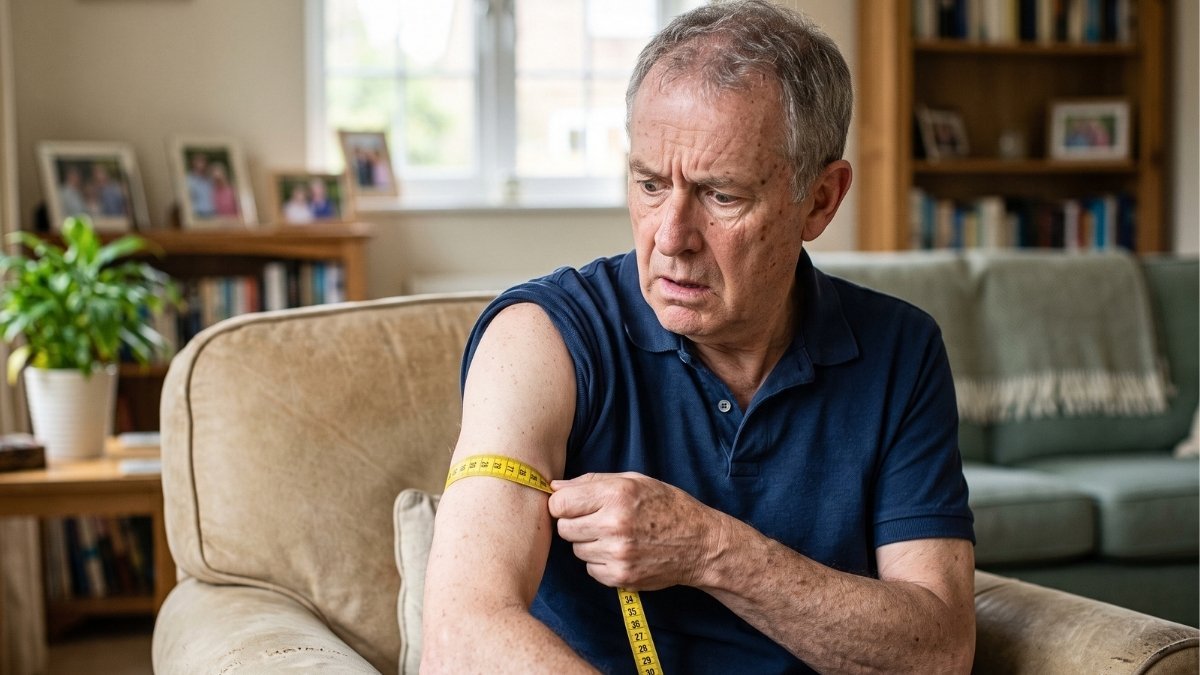
You feel basically fine. You still climb the stairs, carry the groceries in from the car, get up off the couch without thinking about it.
But muscle loss doesn’t announce itself. It shows up as a jar lid you suddenly need help with, a walk that feels a little slower than it used to, a flight of stairs that leaves you more winded than it should.
By the time you notice, a meaningful amount of muscle may already be gone. The actual research on how common this is, and how much muscle is really at stake, is more specific (and more useful) than a single headline number can capture.
Before making any changes based on this article, talk to your doctor, especially if you are currently taking medication or have a diagnosed condition.
What “Losing Half Your Muscle” Actually Means
The idea of losing muscle without realizing it is rooted in something real: sarcopenia, the medical term for age related loss of muscle mass, strength, and function. It’s a recognized condition, not a scare tactic.
Here’s where the numbers get more nuanced than a headline can show. Research on sarcopenia prevalence varies a lot depending on how it’s measured, but a consistent pattern shows up across studies.
Somewhere between 10 and 27 percent of adults over 60 meet the criteria for sarcopenia, and that number climbs sharply with age, reaching as high as half of all adults by the time they’re in their 80s.

So the “50%” isn’t wrong, it’s just aimed at the wrong decade. It’s less about every 60 year old and more about what’s coming if the slide isn’t addressed early.
And the slide starts earlier than most people think: muscle mass declines by roughly 3 to 8 percent per decade starting around age 30, then accelerates considerably after 70.
Muscle strength in the legs specifically can drop by 1.5 to 5 percent every single year after 50, and the thickness of the thigh muscle itself can shrink by close to 40 percent between someone’s 20s and their 80s.
That’s the real story. Not a sudden loss of half your muscle overnight, but a slow, compounding decline that’s easy to miss until it’s already reshaped how your body moves.
Why This Happens Without You Noticing
There are a few overlapping reasons muscle loss stays invisible for so long.
The first is anabolic resistance. As the body ages, muscle becomes less efficient at using the protein you eat to actually build and repair tissue.
The same meal that built muscle at 35 does noticeably less at 65, so if protein intake doesn’t increase to compensate, muscle quietly loses ground.
The second is hormonal. Declining testosterone in men and the drop in estrogen after menopause in women both reduce the body’s natural drive to maintain muscle tissue.

The third is simply inactivity. Many adults gradually reduce how much they move, not out of laziness but because life gets less physically demanding. Fewer heavy grocery trips, more sitting, less climbing.
Muscle responds to demand, and when the demand disappears, so does the muscle.
Finally, low grade inflammation tends to rise with age, and it interferes with the signals that tell muscle to repair and grow. All four of these run in the background, which is exactly why the loss feels invisible until strength or balance is noticeably affected.
Everyone’s body responds differently, so check with your doctor before trying this if you have an existing condition or take medication.
Two Quick Tests You Can Actually Do This Week
Doctors don’t rely on guesswork to spot this. They use a handful of simple, fast tests, and you can try simplified versions of the same ones at home as a starting point for a conversation with your doctor, not a diagnosis on their own.
Clinical Strength Assessments
Three objective tests you and your doctor can use to measure current muscle capacity and identify early signs of physical decline.
SARC-F Questionnaire
Answer five quick questions about your strength, needing help walking, rising from a chair, climbing stairs, and how often you’ve fallen (each scored 0 to 2).
A total score of 4 or higher means it’s worth bringing up with your doctor.
Chair Stand Test
Cross your arms over your chest and stand up fully from a chair, then sit back down, five times as quickly as you can.
Taking longer than 15 seconds suggests weaker leg muscles than expected for your age.
Grip Strength Test
Squeeze a hand dynamometer as hard as you can (many pharmacies, gyms, and physical therapy offices have one).
Below about 59 pounds for men or 35 pounds for women points to reduced overall muscle strength.
The chair stand test in particular is one clinicians lean on heavily, because leg strength predicts fall risk better than almost anything else.
If getting up from a low chair without using your hands has started to feel like a small workout, that’s worth paying attention to.
Try This Today
- Do the five chair stand test right now and time yourself, then repeat it monthly to track any change
- Add one palm sized portion of protein (eggs, chicken, fish, Greek yogurt, or tofu) to whichever meal is currently your lightest
- Pick up something moderately heavy (a bag of rice, a gallon of water) and carry it across the room, twice, most days this week
- Stand up from a seated position without using your hands at least a few times a day instead of pushing off with your arms
- Take a short walk after dinner instead of sitting straight down on the couch
What Actually Rebuilds Muscle After 60
The encouraging part is that sarcopenia isn’t a one way street. Muscle responds to the right inputs at any age, it just takes more deliberate effort than it used to.
Protein is the foundation. The general adult recommendation of 0.8 grams per kilogram of body weight is considered too low for older adults trying to preserve muscle.
Research on aging and muscle metabolism points to somewhere between 1 and 1.6 grams per kilogram daily, spread across meals rather than loaded into one.

Leucine, an amino acid found in eggs, dairy, soy, and lean meat, appears to play an outsized role in triggering muscle repair, so meals built around these foods do more heavy lifting than a single protein shake at the end of the day.
Resistance training is the second pillar, and it doesn’t require a gym membership or heavy weights to matter. Even light resistance work done consistently, two or more sessions a week, targeting the legs, back, chest, and arms with 8 to 12 repetitions per exercise, has been shown to meaningfully slow or partially reverse muscle loss in older adults.
A quick note on numbers like these: individual needs vary based on kidney function, medications, and other health conditions, so any changes to protein intake should be discussed with your doctor first.
Muscle Health: The Balance Ledger
A direct comparison of the daily habits and dietary choices that either build your muscle up or break it down over time.
Protein
Spreading 25 to 35 grams of protein across each meal, aiming for roughly 1 to 1.6 grams per kilogram daily.
Getting most protein at dinner only, or staying near the general minimum of 0.8 grams per kilogram.
Exercise
Resistance training at least twice a week, hitting the legs, back, chest, and arms.
Cardio alone with no strength work, or engaging in long stretches of sitting.
Recovery
Consistent sleep and carefully spacing hard workouts a day or two apart.
Chronic sleep deprivation, which blunts the body’s natural ability to repair muscle.
Nutrients
Leucine-rich foods like eggs, dairy, soy, and lean meat, plus adequate vitamin D levels.
Skipping meals or consistently leaning on low-protein, high-sugar convenience foods.
When To See A Doctor
Most muscle loss develops slowly enough that it’s a conversation for your next checkup, not an emergency. But a few signs mean it’s worth calling sooner rather than waiting.
- Sudden or rapid weakness, especially on one side of the body
- Unexplained weight loss combined with noticeably reduced strength
- A fall, or a near fall, that felt different from your usual balance
- New difficulty with daily tasks you could easily manage a few months ago
A Few Quick Questions

Can muscle loss actually be reversed after 60?
To a meaningful degree, yes. Studies on resistance training and increased protein intake in adults over 60, even those already showing signs of sarcopenia, consistently show gains in muscle mass and strength within a matter of months. Full reversal to a much younger baseline isn’t realistic, but functional improvement is.
How long before I’d notice a difference?
Most research on combined protein and resistance training programs shows measurable strength improvements within 8 to 12 weeks. Muscle mass changes tend to follow a bit more slowly, often becoming visible on tests like the chair stand around the three month mark.
Do I need special equipment to start?
No. Bodyweight movements, resistance bands, and household items like filled water jugs are enough to start. The key factor researchers point to isn’t the equipment, it’s consistency over time.
Is this different for men and women?
The underlying mechanisms are similar, but women tend to see an additional acceleration in muscle loss around menopause due to the drop in estrogen, which is why some clinicians recommend women pay closer attention to strength training starting in their 50s rather than waiting until 60.
Final Thought,
The headline number gets one thing right: this kind of muscle loss really does happen quietly, and a meaningful share of older adults are dealing with more of it than they realize. The exact “50%” figure belongs more to the 80 and older population than to everyone over 60, but the direction of the trend is real and it starts decades earlier than most people expect.
The good news is that two simple tests, a chair and a stopwatch, can give you a rough sense of where you stand today. And the fix isn’t complicated. More protein spread through the day, resistance work a couple times a week, and paying attention when everyday tasks start feeling harder than they used to.