Stay Fit After 60: The 5 Most Effective Full-Body Yoga Moves to Do Every Day
Your body does not care how old your birthday card says you are. It responds to movement. And yoga is one of the best things you can give it after 60.
Here is a fact worth sitting with. According to the National Safety Council, over 43,000 adults aged 65 and older died from preventable falls in 2024 alone. The CDC confirmed in 2026 that the fall death rate rose 21% between 2018 and 2024. More than 1 in 4 adults over 65 falls every year.
These are not numbers about being old. They are numbers about not moving enough.
You do not need a gym. You do not need experience. You do not even need to get on the floor if that feels hard right now. In this guide, you will learn five full-body yoga moves that build strength, balance, and flexibility — and how to use them every single day.
Why Yoga Works So Well After 60
Before we get to the moves, here is why yoga works better than most exercises for people in their 60s and beyond.
After 60, three things decline the fastest: strength, balance, and flexibility. Yoga targets all three at the same time. And it does it without punishing your joints.
A 2024 study published in GeroScience followed 258 sedentary adults aged 60 to 80 for 26 weeks. The yoga group improved across 10 markers of healthy aging — including physical strength, mental function, metabolic health, and social well-being. That is not one benefit. That is ten.
There is also a sedentary problem. A 10-country study found the average adult over 60 sits or lies down for 9.4 hours every day. Yoga breaks that cycle. It requires no equipment, costs nothing, and can be done in your living room.
Now let us get to the five moves that do the actual work.
Safety First: Read This Before You Start
Before you begin, take a moment to prioritize your safety. Talk to your doctor, especially if you have osteoporosis, recent surgery, heart conditions, or balance issues. You don’t need to get on the floor—every move has a chair version, and it works just as well.
Never push into pain. Gentle stretching is okay, but sharp pain is a clear signal to stop. Use a wall or sturdy chair for support during balance exercises, and start with three days a week. Focus on steady progress, not perfection—your goal is to stay active and independent.
The 5 Full-Body Yoga Moves for Seniors Over 60
Pose 1: Mountain Pose (Tadasana) — Your Daily Reset
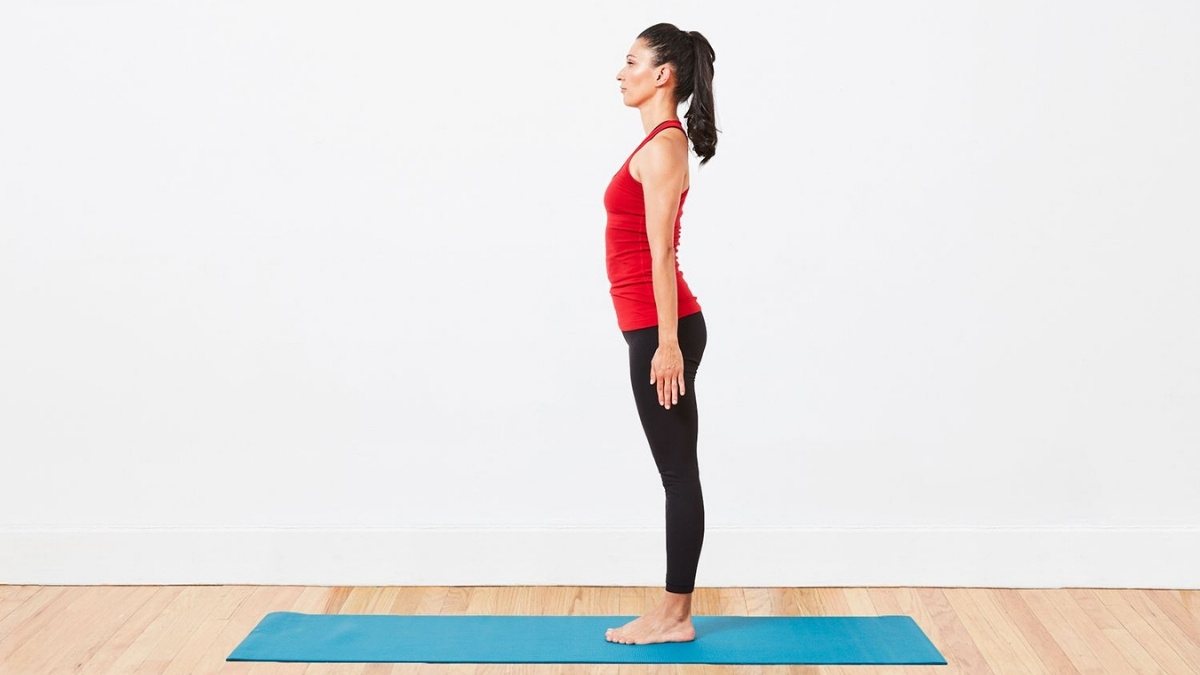
What it works: Posture, core, balance awareness, feet, and legs.
This is not just standing still. Mountain Pose is an active engagement of nearly every muscle in your body.
Here is how to do it. Stand with your feet hip-width apart. Press all four corners of both feet into the floor. Gently squeeze your thigh muscles. Lift your chest slightly. Roll your shoulders back and down. Let your arms hang with palms facing forward. Breathe slowly for 5 to 10 breaths.
Chair version: Sit at the edge of your chair. Both feet flat on the floor. Spine tall. Do not lean into the backrest.
How long: Hold for 30 to 60 seconds. Repeat 2 to 3 times.
Poor posture gets worse after 60 because muscles weaken and most people sit for hours every day. This pose fights that. SilverSneakers yoga instructors note that Mountain Pose alone — done for just one minute — is a valid daily practice on days when you cannot do more.
Start here. Always.
Pose 2: Cat-Cow Flow (Marjariasana) — Your Spine’s Daily Lubricant
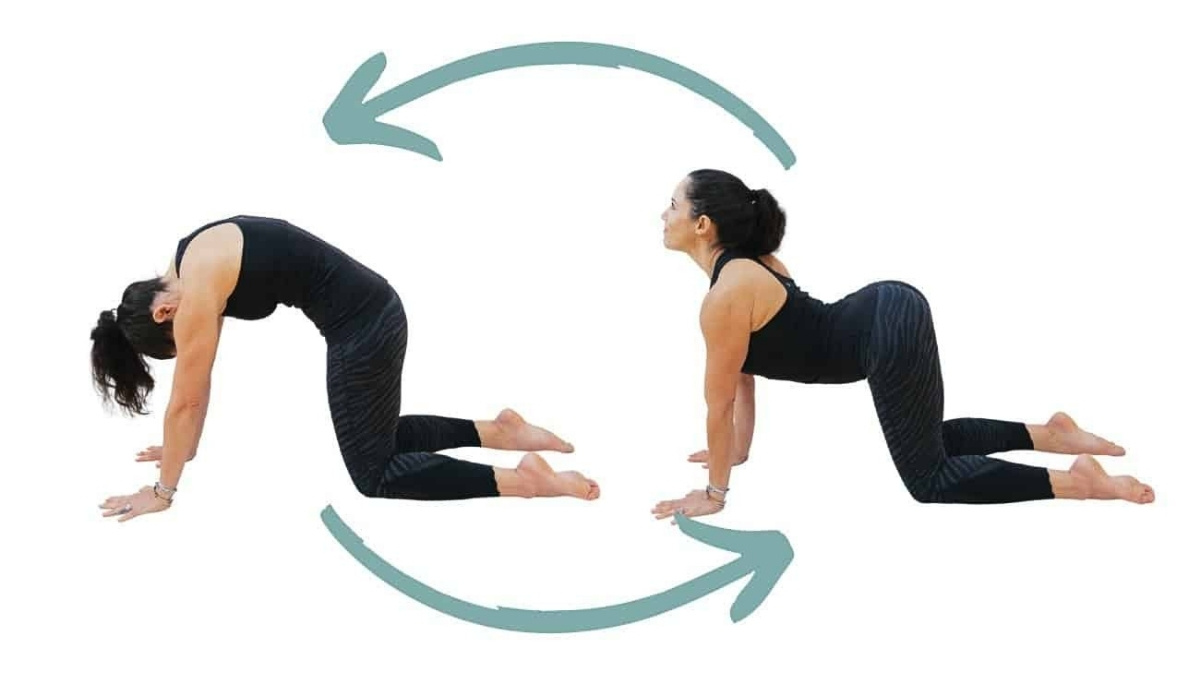
What it works: Entire spine, lower back, abdomen, neck, and hips.
Your spine stiffens with age. Stiffness leads to pain. Pain leads to less movement. Less movement leads to more stiffness. Cat-Cow breaks that cycle.
A 20-week study of women aged 50 to 79, cited in NIH research, found that regular spinal yoga movement led to greater spinal mobility, stronger back muscles, and stronger abdominal obliques. That is real structural improvement.
Here is how to do it. Start on your hands and knees. Wrists under shoulders, knees under hips. Inhale and drop your belly toward the floor while lifting your chest and tailbone — that is Cow. Exhale and round your spine toward the ceiling while tucking your chin — that is Cat. Move slowly. Let your breath lead the movement. Do 8 to 10 rounds.
Chair version: Sit upright. Inhale and arch your back gently, lifting your chest. Exhale and round your spine, dropping your chin. Same motion, no floor required.
How long: 8 to 10 slow breath cycles. Do 1 to 2 sets.
If it is done right, you will feel a wave-like movement from your tailbone all the way up to your neck.
Pose 3: Warrior I (Virabhadrasana I) — Build Leg Strength and Stop Falls
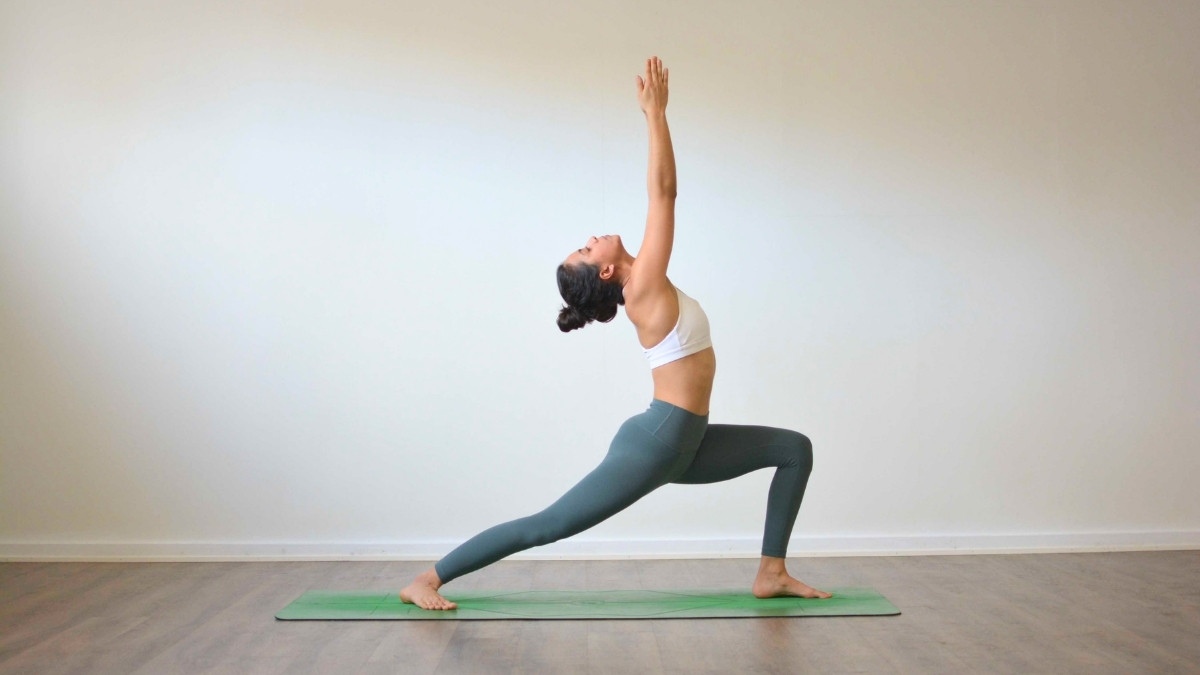
What it works: Quadriceps, hamstrings, glutes, hip flexors, core, and shoulders.
Leg weakness is a direct cause of falls. Warrior I targets the exact muscles you need to climb stairs, get off the couch, and walk without wobbling.
Senior care specialists at Timber Ridge rank Warrior I among their top pose recommendations for older adults. It builds leg strength and trains your body awareness at the same time.
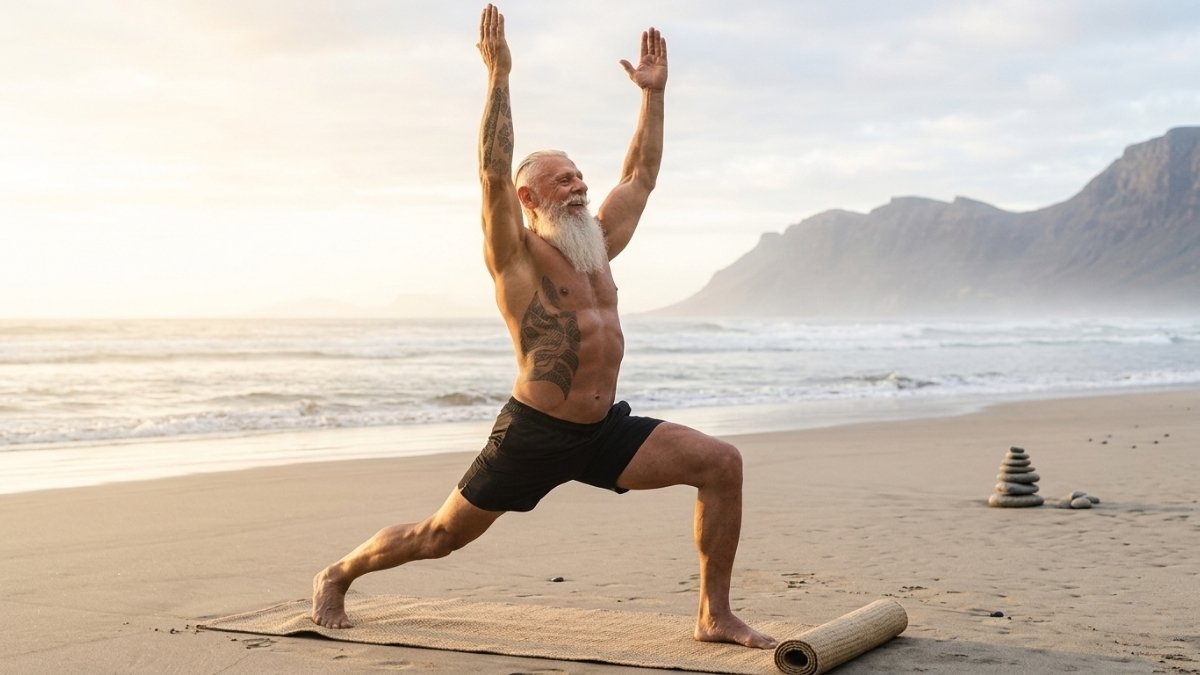
Here is how to do it. Stand facing forward. Step one foot forward about 3 to 4 feet. Turn your back foot out 45 degrees. Bend your front knee as far as comfortable — do not force 90 degrees. Raise both arms overhead. Hold for 5 breaths. Switch sides.
Chair version: Sit sideways on the chair. Extend one leg back with your toes resting on the floor. Raise both arms overhead. Hold for 5 breaths. Switch sides.
How long: 5 breaths per side. Repeat 2 rounds.
Never push into knee pain. Work at whatever depth your body allows today. That depth will increase over time.
Pose 4: Tree Pose (Vrikshasana) — Train Your Balance Every Day
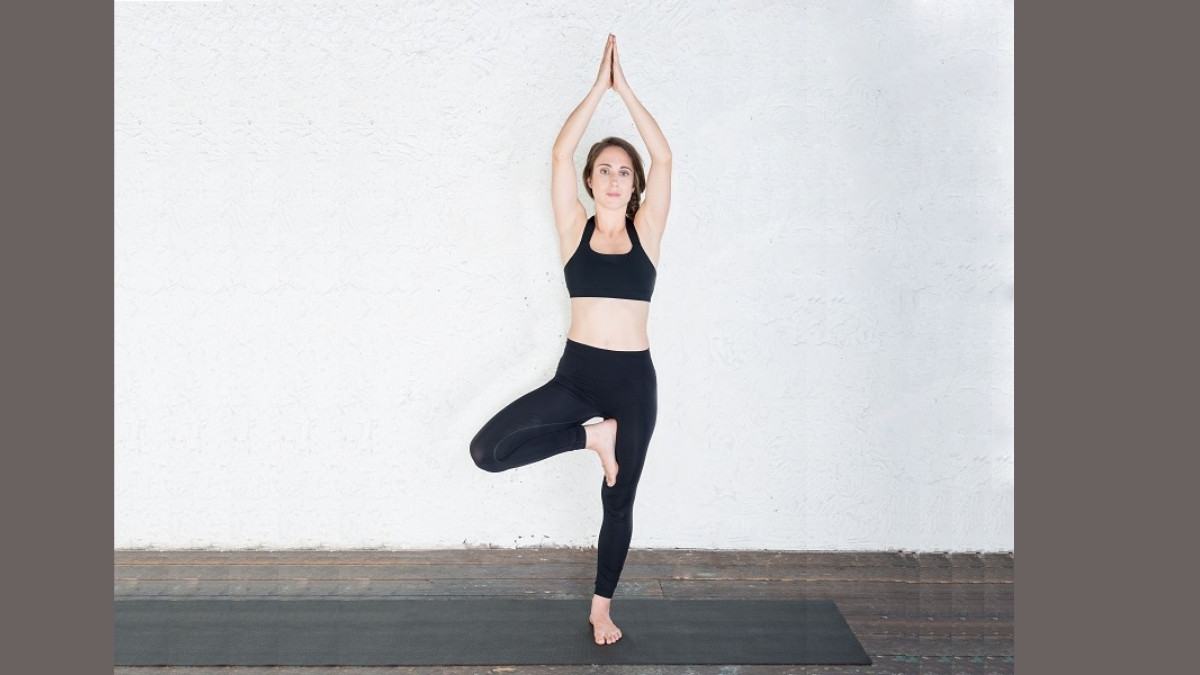
What it works: Standing leg, ankle stability, core, and mental focus.
Balance is the first physical skill to go after 60. You notice it when you reach for something, step off a curb, or stand on one foot to put your pants on. Tree Pose directly trains your balance system every single day.
The Age and Ageing systematic review confirmed that yoga-based movement improves balance and mobility in people over 60. Tree Pose is the most direct balance-building tool in yoga.
Here is how to do it. Stand near a wall. Place one hand lightly on the wall. Shift your weight to one foot. Place your other foot either on your calf — never the knee — or simply rest your toes on the floor as a kickstand. Press your palms together at your chest. Hold for 5 to 10 breaths. Switch sides.
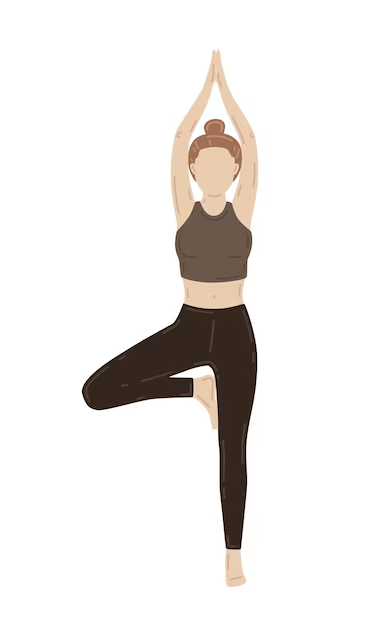
Modification: You do not have to lift your foot at all. Even shifting weight to one leg while touching a wall trains your balance.
How long: 5 to 10 breaths per side. 2 rounds.
Use the wall. There is no prize for falling.
Pose 5: Child’s Pose (Shishuasana) — Release Everything and Recover
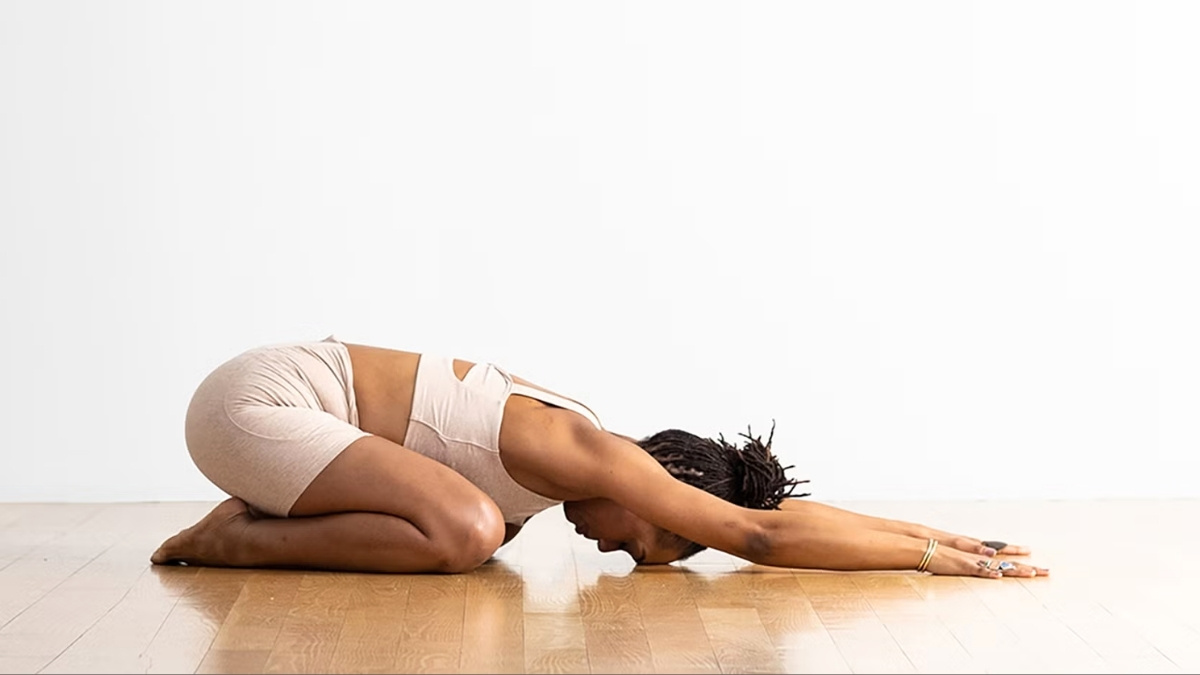
What it works: Lower back, hips, thighs, shoulders, and the nervous system.
Nearly every adult over 60 carries chronic tension in their lower back and hips. Most of it builds silently over years of sitting, poor posture, and stress. Child’s Pose releases it all at once.
The Art of Living calls this pose essential for reducing back aches and helping the body absorb the benefits of other poses. It also activates the parasympathetic nervous system — your body’s rest and recovery mode.
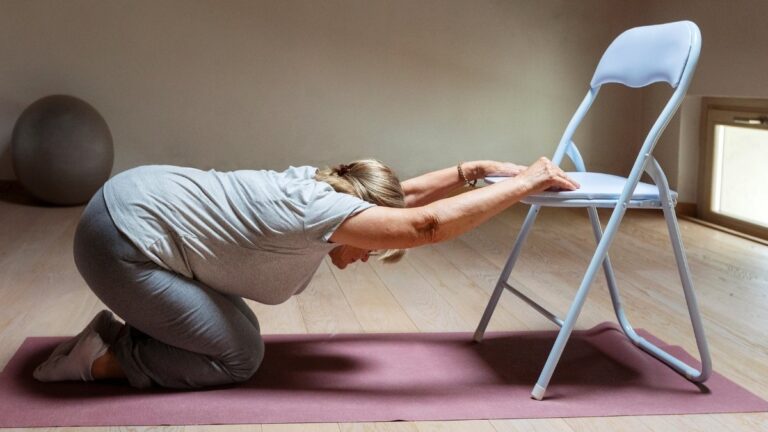
Here is how to do it. From hands and knees, push your hips back toward your heels. Extend your arms forward and rest your forehead on the mat. If your hips do not reach your heels, place a folded blanket between your hips and heels for support. Hold for 5 to 10 slow breaths.
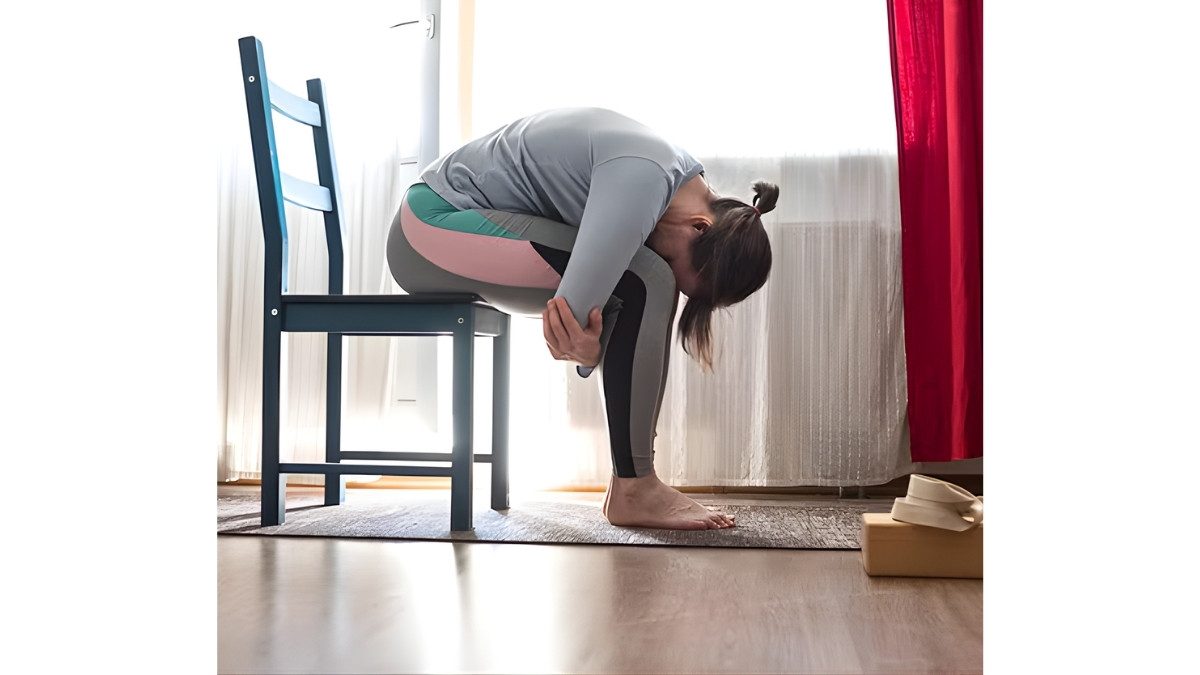
Chair version: Sit at the edge of the chair. Open your knees wide. Slowly fold your torso forward between your thighs. Let your arms hang or rest on the floor. This fully decompresses your lower spine.
How long: 5 to 10 breaths. Always end your session with this pose.
How to Build Your Daily Routine With These 5 Moves
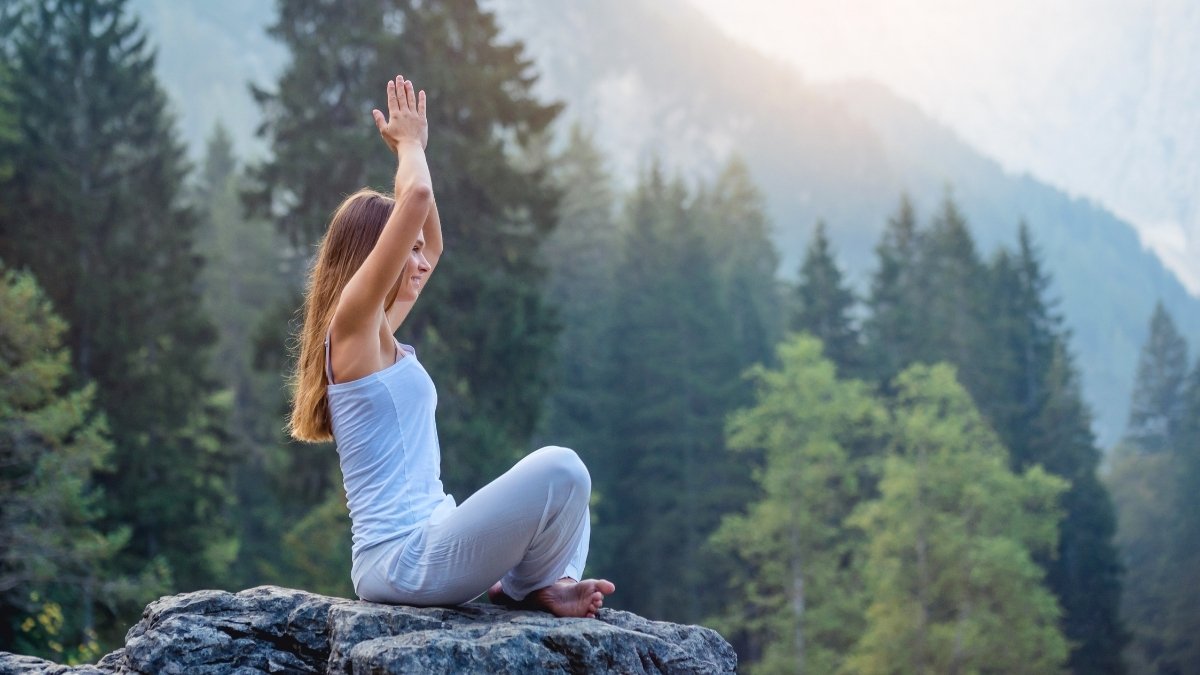
The full routine takes 15 to 20 minutes. That is it.
Follow this sequence every time: Mountain Pose → Cat-Cow → Warrior I → Tree Pose → Child’s Pose. This order is not random. It moves your body from grounding and awareness, into spinal warm-up, into strength, into balance training, and finally into recovery. It follows a logical, safe progression.
Morning is the best time. Your joints are stiff after sleep. This routine loosens them gently. But any consistent time of day works. Consistency matters more than timing.
The NHS recommends that adults over 60 do strength, balance, and flexibility activity at least twice a week. A June 2025 BetterMe expert review confirmed yoga is safe to do daily for gentle practices like these five poses.
One honest note: yoga alone does not fully cover the 150 minutes of weekly aerobic activity recommended by the CDC. Pair this daily yoga routine with 20 to 30 minutes of brisk walking on most days. Together, those two habits cover every major fitness need for adults over 60.
What Results Can You Actually Expect — And When?
Here is a realistic timeline. No exaggeration.
Week 1 to 2: Morning stiffness decreases. You breathe more slowly and deliberately. Sleep may improve slightly. These are real changes, even if they feel small.
Week 3 to 4: Your balance feels steadier. Getting up from a chair or climbing stairs feels easier. You start to trust your body more. That confidence is not small — it directly reduces your fall risk.
Week 6 to 8: NIH research shows that 8 to 12 weeks of moderate yoga practice produces measurable improvements in flexibility, strength, and quality of life in adults over 60. You will feel this, not just read about it.
Mental health: Studies show seniors aged 65 to 75 who did 90 minutes of yoga per week for just one month had significant reductions in anxiety scores. That is one month. Roughly four weeks of practice.
Long-term: A 2025 meta-analysis confirmed that yoga therapy outperforms light exercise for insomnia, depression, stress, and constipation in the 60 to 75 age group. A 2024 GeroScience study with 258 adults aged 60 to 80 showed improvement across 10 healthy-aging markers after 26 weeks. These are not small gains. These are life-quality gains.
Lastly,
You do not need a gym. You do not need to be flexible. You just need to start.
These five poses cover every major physical need after 60 — posture, spine, strength, balance, and recovery. Fifteen minutes a day. Done consistently, the results are real, proven, and worth your time.
Start tomorrow morning.