Radio Taiso: The 3-Minute Morning Exercise Japan Has Done Since 1928—Now Going Viral on YouTube

Every morning at exactly 6:30 a.m., roughly 27 million people across Japan stop what they’re doing — in parks, offices, schools, and kitchens — and do the same 13 movements they’ve been doing since 1928.
You know you should move your body in the morning. But 45-minute workouts feel impossible. And the guilt of skipping them only makes it worse.
Radio Taiso is the answer most people haven’t heard of yet. It’s a Japanese morning exercise routine that takes just 3 minutes, needs zero equipment, and has real science behind it.
In this article, you’ll learn what it is, where it came from, why it’s now going viral on YouTube, and exactly how to start doing it tomorrow — for free.
This article is structured into 7 points—read them one by one to discover how Radio Taiso, Japan’s 3-minute morning exercise tradition since 1928, is boosting health and going viral again.
Point One: What Is Radio Taiso? The 97-Year-Old Routine Most of Japan Knows by Heart
Radio Taiso (ラジオ体操) means “radio exercise.” It’s a set of calisthenics broadcast every morning on NHK Radio 1 at 6:30 a.m. It has run without interruption since 1928.
There are three versions. Radio Taiso
No. 1 lasts 3 minutes 10 seconds and works for all ages.
No. 2 runs 3 minutes 5 seconds
And is slightly more intense, built for the workplace.
Minna no Taiso takes 4 minutes 30 seconds and is the gentlest of the three.
Each version uses 8 to 13 full-body movements — arm circles, side bends, body twists, knee bends, and marching in place — all synced to a simple piano melody. No weights. No mat. No gym clothes.
A 2022 study from the Tokyo Metropolitan Institute for Geriatrics found that 96.9% of Japan’s population knows what Radio Taiso is. You can access all versions free on YouTube, NHK’s website, or through the Japan Radio-Taiso Federation. It’s one of the most widely practiced free fitness routines in human history.
Point Two: Where Did Radio Taiso Come From? A Brief History Worth Knowing
Radio Taiso did not start in Japan. It started in America.
In the 1920s, two representatives from Japan’s Postal Life Insurance Bureau visited the United States. They found a radio fitness program running in several U.S. cities, sponsored by Metropolitan Life Insurance and accompanied by a live pianist. They brought recordings back home.
Japan’s postal service partnered with NHK and launched its own version on November 1, 1928. The first public performance had 20,000 postal workers doing the routine together in the streets. The current Radio Taiso No. 1 has been broadcast in its exact form since 1951 — over 70 years of the same routine.
It survived wars, recessions, and cultural shifts. After the 2011 Great East Japan Earthquake, communities in Ishinomaki, Miyagi used Radio Taiso as a tool to bring people back together.
Local groups started a campaign called “Orahono no Radio Taiso,” using the morning routine to rebuild social connection in devastated neighborhoods. That’s when you realize this is more than exercise — it’s infrastructure.
Point Three: Why Is Radio Taiso Going Viral on YouTube in 2025–2026?

Trend research firm Glimpse tracked approximately 12,000 monthly global searches for Radio Taiso as of November 2024. YouTube and Instagram are driving most of that growth.
The timing makes sense. Over the past few years, people have become deeply curious about Japanese health culture — ikigai, hara hachi bu, longevity diets. Radio Taiso fits right into that interest. It’s a real, practiced tradition, not a trend invented for social media.
The Japan Society UK published an official follow-along video with certified Radio-Taiso Federation instructor Risa Ono. It’s clean, easy to follow, and completely free. Millions of people burned out on HIIT workouts or 30-day challenges are finding it and staying.
Animal Crossing: New Horizons also played a surprising role. The game featured a Radio Taiso mini-game, which introduced the routine to millions of younger players worldwide who had never heard of it.
A U.S.-based educator at Radiotaiso.com has been running it with students daily for three years and now hosts weekly Zoom sessions and in-person park meetups across California, Oregon, and Washington.
Point Four: The 13 Movements — What You Actually Do in 3 Minutes
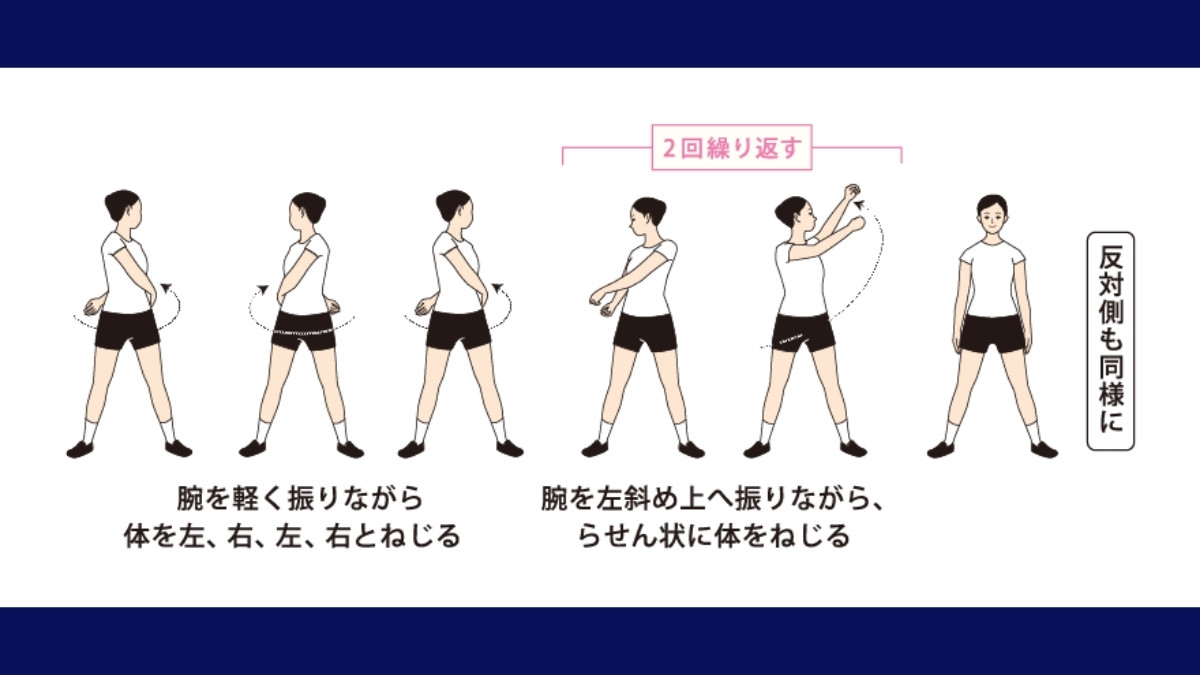
You don’t need to memorize anything before you start. But here’s what happens in those 3 minutes and 10 seconds.
Radio Taiso No. 1 has 13 movements. They flow in order — starting gently, building through the middle, then cooling down at the end. That design is intentional. It was built to be safe for every age and body.
The movements include a full-body overhead stretch, arm circles (forward and backward), lateral side bends, waist twists, a forward bend paired with a chest opener, gentle knee bends, arm swings with small jumps, marching in place with knees raised, and a final full-body reach to close.
Each movement targets something different — shoulders, spine, hips, legs, core. Together they cover muscle strength, flexibility, agility, balance, endurance, and coordination. All in one session.
You need about 4 square feet of floor space. The Japan Society UK offers a free printable illustrated movement card at japansociety.org.uk so you can see each step before you try it.
Point Five: How to Start Doing Radio Taiso Tomorrow Morning (Step-by-Step)
Here is the full plan. Six steps. Zero equipment. Completely free.
Step 1 — Pick your version. Start with Radio Taiso No. 1. It’s 3 minutes 10 seconds and built for all ages.
Step 2 — Find your video. Search “Radio Taiso No. 1” on YouTube. The Japan Society UK channel has English instruction from certified instructor Risa Ono. NHK World YouTube has the original Japanese version.
Step 3 — Pick a consistent time. 6:30 a.m. is traditional, but any morning time works. Consistency beats perfect timing.
Step 4 — Clear 4 square feet. No mat, no shoes, no gym clothes. Pajamas are fine.
Step 5 — Follow along for the first week. Most people memorize all 13 movements within 5 to 7 days.
Step 6 — Join a community if you want one. Radiotaiso.com hosts weekly Zoom sessions open to anyone, plus in-person park meetups in California, Oregon, and Washington.
One habit-stacking tip that works: Coffee → Radio Taiso → Shower. Attach it to something you already do every morning.
Point Six: Radio Taiso vs. Other Morning Routines — An Honest Comparison

Let’s be direct. Radio Taiso is not the best workout for building muscle or losing fat fast. That’s not what it’s for.
What it wins at is consistency. The 2024 clinical trial showed a 94.1% daily adherence rate. Most gym routines see dropout rates of 50% or more within three months. Radio Taiso takes 3 minutes. There’s almost nothing to skip.
Compared to yoga: Radio Taiso is faster, needs no prior knowledge, and includes a light cardio component. Yoga offers deeper stretching and mindfulness, but it asks more of your time and attention. Compared to HIIT: HIIT changes body composition faster, but injury rates and dropout rates are much higher. Radio Taiso’s 3.7 METs intensity is safe enough to do every day for decades.
Compared to doing nothing: 27 million people in Japan are still doing Radio Taiso in their 70s and 80s. That long-term consistency is the real advantage. If your goal is to build a morning movement habit that actually sticks, this is one of the best-proven options available.
Point Seven: Who Is Doing Radio Taiso Around the World Right Now?
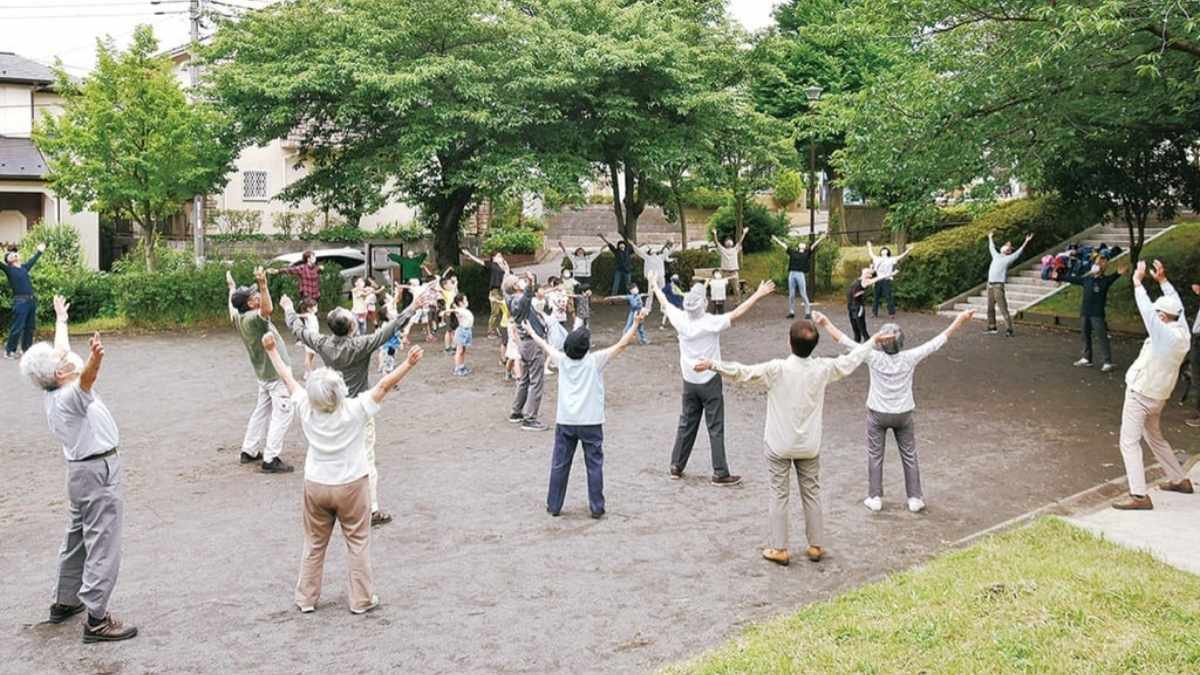
Radio Taiso is not just a Japanese tradition. People are doing it globally, right now, in 2026.
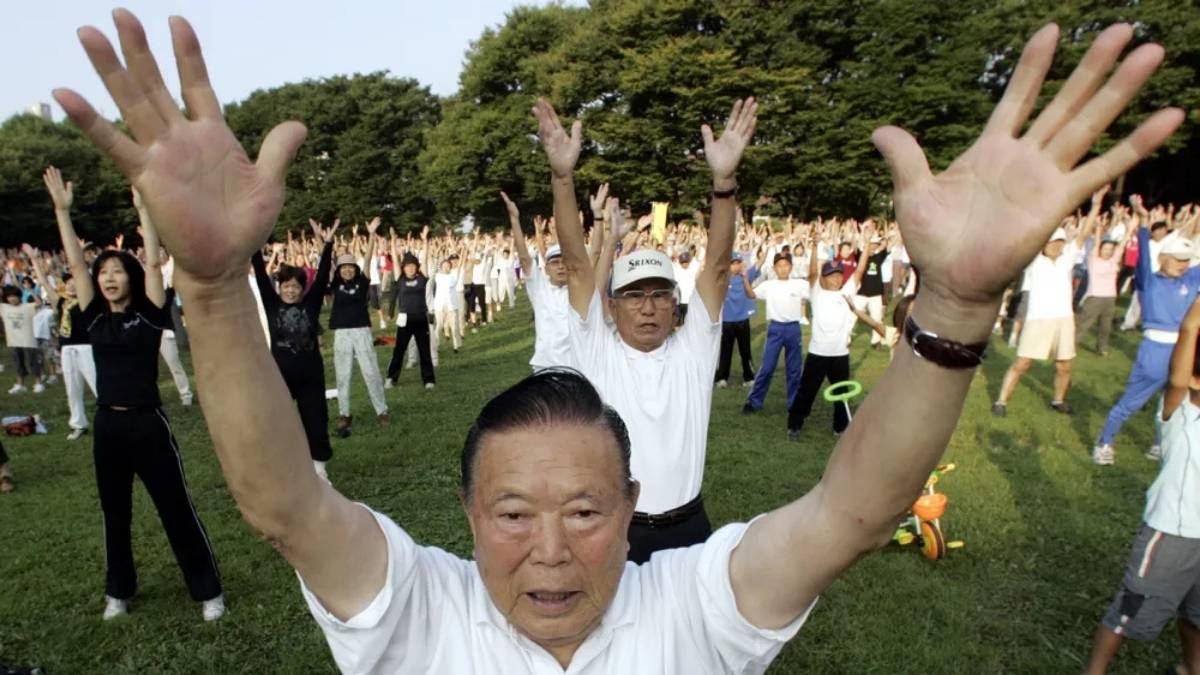
In Tokyo, more than 100 people gather at Rinshi-no-mori Park every morning before 6:30 a.m. They bring a portable speaker, space out arm’s-length apart, and follow the same piano melody together. Kazu Shimomura, a 73-year-old daily practitioner quoted by Worldcrunch in July 2025, described it as both physical and social — something he looks forward to, not dreads.
In the United States, Radiotaiso.com has hosted public sessions in Anaheim, Santa Ana, Portland, Newport (Oregon), and Tacoma (Washington). Their weekly Zoom streams are open to anyone worldwide.
In the UK, the Japan Society has integrated Radio Taiso into school curriculum packs as part of Japanese Sports Day programming. In U.S. classrooms, Michigan State University Extension has featured it as a cultural wellness practice for students.
Conclusion:

Radio Taiso has worked for 27 million people across 97 years because three minutes is something anyone can actually do — every single day. The science is real. The community exists. The videos are free.
Search “Radio Taiso No. 1” on YouTube tonight. Do it once tomorrow morning. That’s your entire Japanese morning exercise routine. Start there.