

You’ve spent years hearing that more protein means a longer, stronger life, so being told the opposite can feel like a trick. That reaction makes sense, because for decades protein has been marketed as the one nutrient you can’t overdo.
Adults in their 50s and early 60s trying to eat healthier as they age keep running into advice that flatly contradicts itself. New research suggests eating less protein, not more, may extend your life, but only during one specific window of adulthood.
By the end of this article, you will know exactly which age group this applies to, and which one it does not.
What Eating Less Protein Does to Your Long-Term Odds

You want to know if cutting back on protein is actually worth it. Here’s the direct answer: for adults in their 50s and early 60s, eating less protein is linked to a lower risk of dying over the next two decades.
Picture two people in their late 50s, one eating meat and protein shakes daily. The other eats less protein and more vegetables and grains.
That’s where the real numbers come from: a study that followed thousands of adults like them for 18 years.
If you’d been in the high protein group, the numbers were stark: your risk of death from any cause would have been 75 percent higher, and your risk of dying from cancer about four times higher.
Before you put too much weight on that number, here’s the caveat: this was an observational study, not a controlled experiment, so it shows a strong link, not proof that protein caused the difference.
In plain terms, your odds may shift more than you’d expect. That’s true only if protein makes up a large share of your daily plate.
What this number doesn’t tell you yet is whether it applies to your exact age.
The Age Cutoff Nobody Mentions
You just read that eating less protein might help you. Here’s the detail most articles about protein intake by age leave out completely.
If you’re 66 or older, the same study has different news for you: in that group, the pattern completely flipped toward more protein.
For that older group, higher protein was linked to lower rates of death and cancer.¹ The direction of the advice depends entirely on age.
This is not a small footnote buried in the data. One blanket rule cannot cover every adult at every age.
Nobody handed you a simple chart for protein intake by age. That gap is part of why this topic feels so confusing.
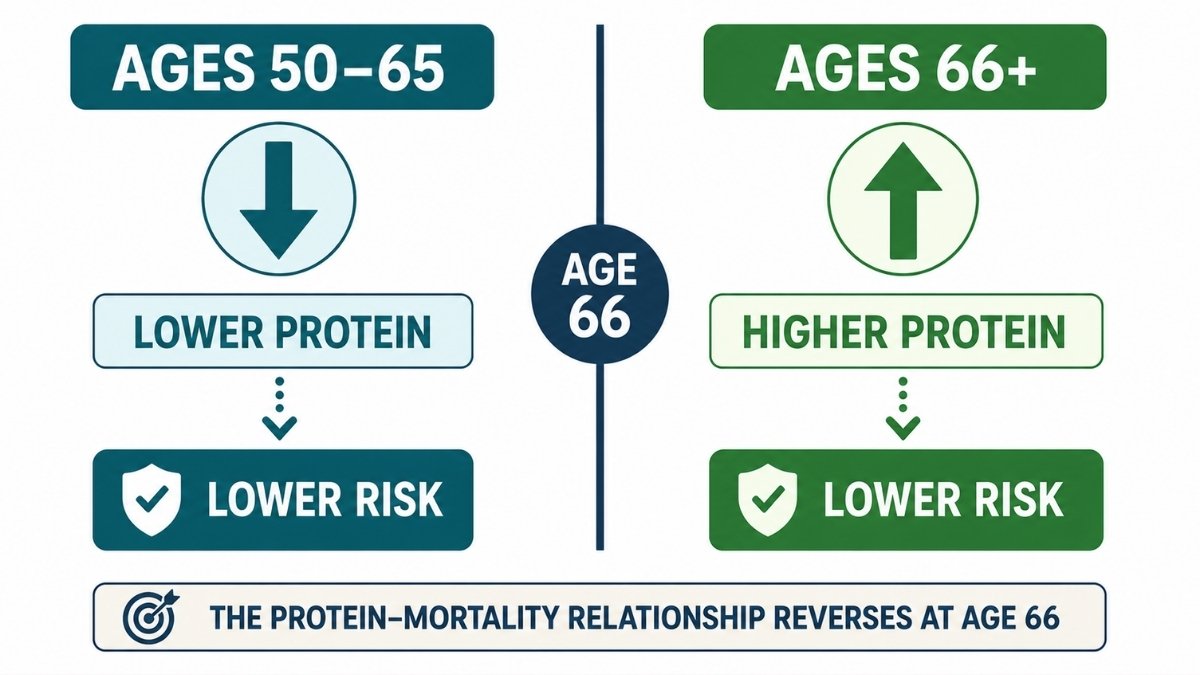
Which Group Are You In? If you’re 50 to 65 and generally healthy, this research suggests eating less protein may be worth discussing with your doctor.
If you’re 66 or older, the same study found the opposite pattern, and higher protein was linked to better outcomes. That single number, 66, changes which direction this advice points for you. Your age matters more here than any single headline, no matter how convincing it sounds.
Knowing which side of that line you’re on only helps once you understand why the line exists inside your body.
What’s Happening Inside Your Body
You don’t need a science background to understand this. Your body reads protein as a growth signal, and two systems pick up on it.
The first is a hormone called IGF-1 [a growth hormone that tells cells to grow and divide]. Diets high in protein raise IGF-1, and lower protein brings it back down.
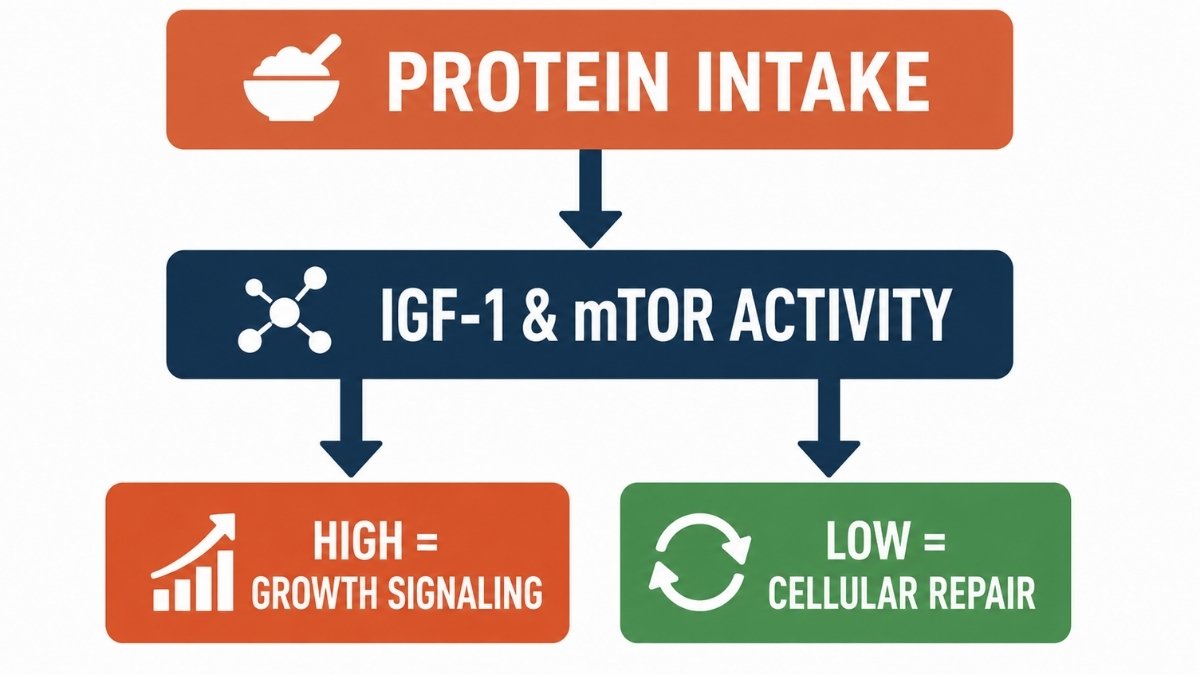
Here’s proof this isn’t just a guess: in a controlled study, researchers lowered protein intake in six volunteers already restricting calories over three weeks. Their IGF-1 levels dropped as a direct result of eating less protein.
The second system, called mTOR [a cell pathway that controls growth, repair, and cleanup], works alongside IGF-1. Scientists describe lower activity in both systems as a shift toward repair.²
Think of it like a construction crew. High protein keeps the crew building nonstop, while lower protein gives it time to repair what’s already there.
Knowing how the mechanism works is one thing. Knowing whether it holds up over a full lifetime, including in animals, is another question.
What Animal Research Adds
Mice gave researchers a clue that human data alone couldn’t offer. There’s one catch you should know upfront.
In a study, researchers restricted one amino acid called methionine [a protein building block found mostly in meat, eggs, and dairy], starting when the mice reached middle age.
Mice on the low-methionine diet appeared to live longer than mice on a normal diet. That’s a meaningful result, since the restriction started well into their lives, not at birth.
Here’s the nuance worth knowing: the same study found that methionine restriction didn’t produce the exact same liver signaling changes as calorie restriction did. That suggests the two approaches may extend lifespan in mice through different biological paths, even though both work.

Animal research suggests this may apply to humans, but human studies haven’t confirmed it. Mice and people differ in lifespan and metabolism in important ways.
No human trial has tested whether eating less protein, or less methionine, starting in middle age actually extends human lifespan. What exists is a strong hint, not final proof.
That gap between what mice show and what humans have proven is exactly why the next part matters, especially if you’re already older.
Talk to your doctor before changing your protein intake if you’re over 65, managing a chronic illness, recovering from surgery, or losing weight without trying.
Why Cutting Too Far Can Backfire
If you’re tempted to cut protein sharply starting today, slow down for a moment. Muscle loss is one of the biggest threats to living independently as you age.
Health groups that study aging recommend different protein amounts depending on your situation, not one universal number:
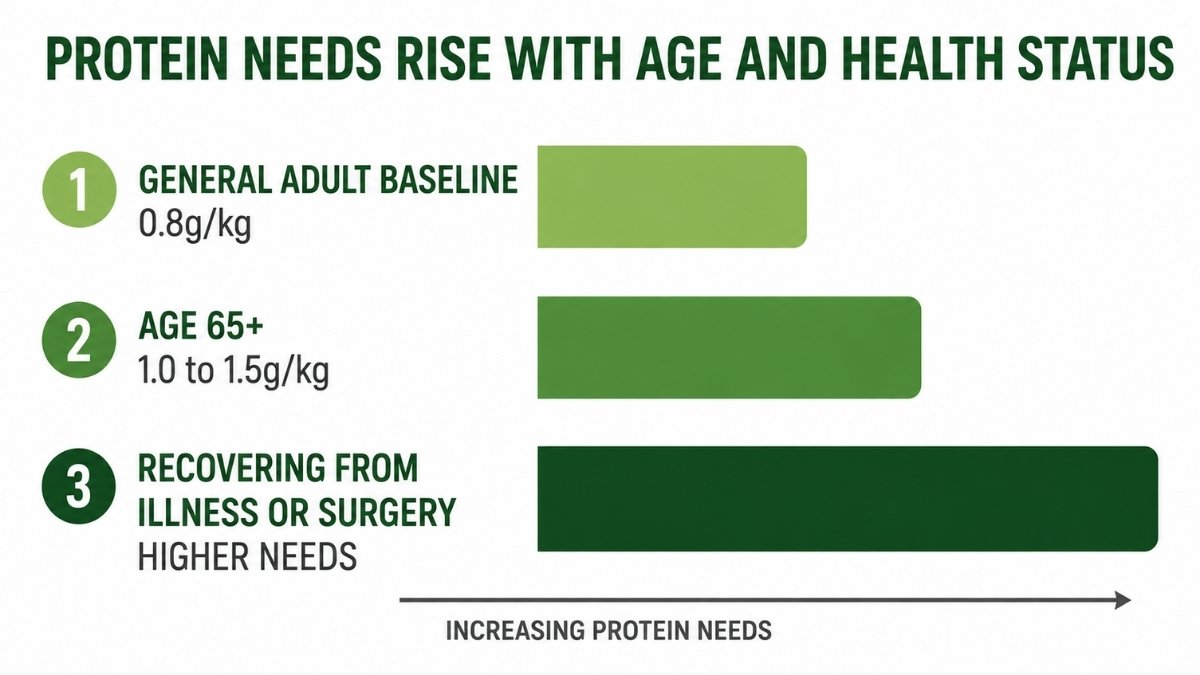
None of these numbers contradict the research in this article. They simply describe a different group of people than the one that study covered.¹
The number that actually applies to you is the only one worth remembering, and that’s what comes next.
The Bottom Line,
The single most useful thing you can do today is figure out which age group you’re actually in, not which headline sounds most convincing. Talk to a doctor or dietitian about the right protein amount for your age and health before changing your diet.

That conversation, not eating less protein on your own, is what turns this research into something useful for you specifically. Protein needs change with age, and pretending otherwise is what got you confused in the first place.