
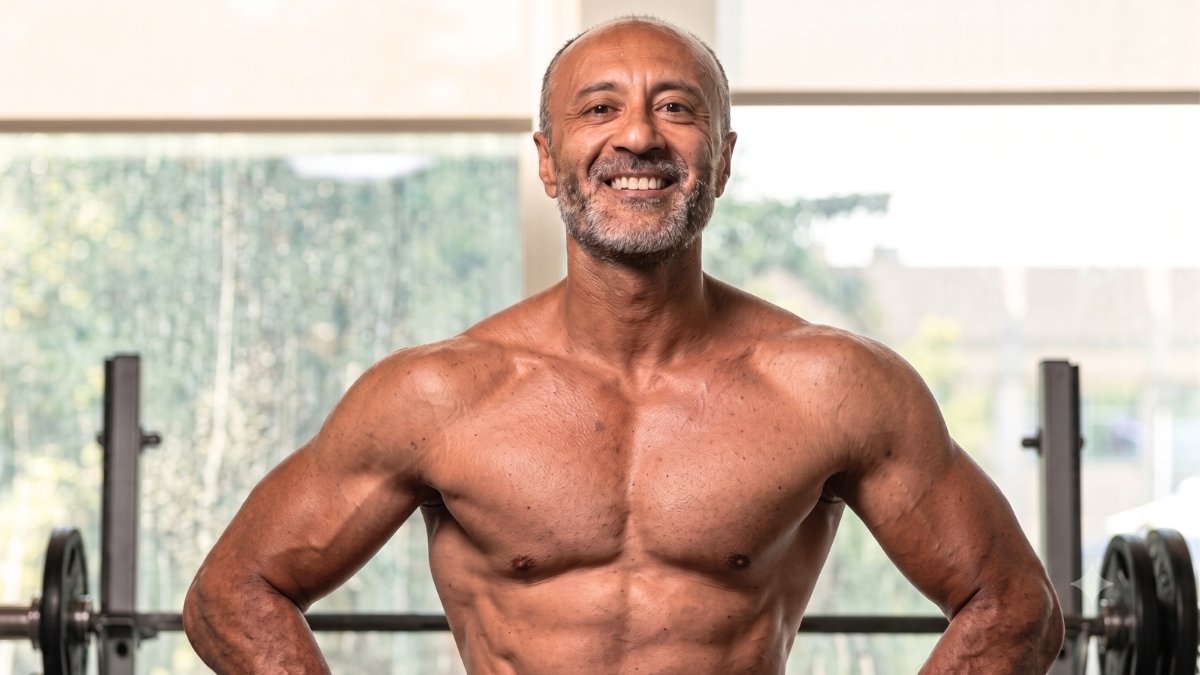
Here’s a number that might stop you cold. People with weak grip strength have a much higher risk of getting dementia than people with strong grip. This isn’t a guess. It comes from a study that tracked almost 500,000 adults for nine years.
Most people lift weights to look better or feel stronger. Few know it also protects the brain. Every time your muscles work, they send chemical signals through your blood. Those signals reach your brain and help protect your memory.
This article breaks down that science in plain words. Then it gives you a simple weekly plan you can start today.
Neuromuscular Brain-Shield Auditor
Measure your current neuromuscular vitality and discover how your muscle mass is actively influencing your dementia risk and memory retention.
Step 1: The Resistance Baseline
Muscle loss starts in your 30s. How often do you actively perform resistance training (lifting weights, heavy bands, or bodyweight)?
Step 2: Motor-Unit Firing Test
Weak grip strength correlates to a massive spike in dementia risk. This 10-second rapid-tap test acts as a digital proxy for your fast-twitch motor unit responsiveness.
Tap the central circle as rapidly as possible until the timer hits zero.
Synthesizing BDNF Markers…
Calculating myokine release potential based on your neuromuscular output.
Cognitive Armor Level
The 2-Day Brain Shield Protocol
To actively reverse muscle atrophy and pump Irisin to your hippocampus, execute this 45-minute clinical routine twice per week.
📖 The Chemical Connection
To understand exactly how the Myokine proteins Irisin and Cathepsin B cross the blood-brain barrier to restore memory function, read the full article below.
Why Your Muscles Send Signals to Your Brain
Your muscles are not just for lifting things. They act like a chemical factory. Every time you use them, they release small proteins into your blood.
Scientists call these proteins myokines. Two of them matter most for your brain: irisin and cathepsin B. Both of these proteins can cross the blood-brain barrier and trigger the production of BDNF in the brain, which leads to the growth of new brain cells in the hippocampus. Oxford AcademicPubMed Central

BDNF stands for brain-derived neurotrophic factor. Think of it as fertilizer for brain cells. Your hippocampus is the part of your brain that stores memories, and BDNF helps it grow.
This isn’t just a lab theory about mice. In mouse studies, irisin in the blood has been shown to restore memory function that was lost due to Alzheimer’s-like disease. Blocking irisin removed that benefit. That tells researchers the muscle-to-brain signal is doing real work, not just showing up alongside it. PubMed Central
NYU neuroscientist Wendy Suzuki puts it simply. She compares the brain to a muscle, saying the more you work out, the bigger and stronger your hippocampus and prefrontal cortex become over time. Those two brain areas are the ones most affected by aging and disease. So building them up now pays off later. NPR
The Proof: What Happens When Your Muscles Get Weak
Let’s look at the actual numbers behind that opening statistic. A team of researchers followed 466,788 adults through the UK Biobank study. They measured grip strength using a simple hand-squeeze device.
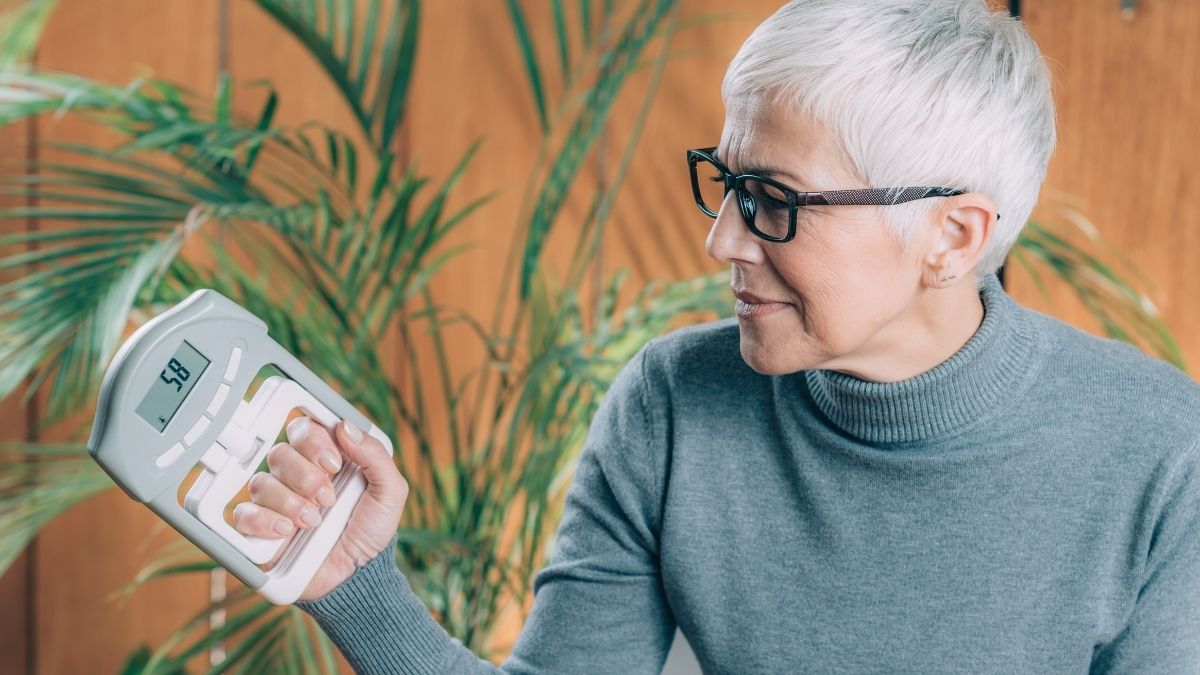
The results were hard to ignore. People in the weakest grip-strength group had a 72% higher risk of developing dementia, and a 87% higher risk of dying from it, compared to people in the strongest group. The researchers estimated that low grip strength accounted for about 30% of all dementia cases in the study.
A separate U.S. study found something similar. For every 1 kg increase in grip strength, dementia risk dropped by about 2%. That might sound small. But it adds up fast across a whole population. nih
Now, here’s an honest point. Grip strength studies only show a link. They don’t prove that training your grip alone fixes your brain. For that, you need trials where researchers actually assign people to lift weights and then measure what happens.
That evidence exists too. A 2025 review of 17 randomized trials found that resistance training led to real improvements in overall thinking skills, working memory, and both verbal and spatial memory in older adults. These were controlled experiments, not just observations. That makes the case much stronger. PubMed

One more study compared five types of exercise against each other. Resistance training came out ahead of the rest for improving overall brain function, with the biggest gains showing up after twice-weekly, 45-minute sessions done over 12 weeks. That’s a specific, doable target you can actually plan around. Frontiers
The Warning Sign You Can’t See Coming
Here’s the part that surprises most people. Muscle loss doesn’t start at 60. It starts in your 30s.
After age 30, you begin losing about 3% to 5% of your muscle mass every decade, and most men lose about 30% of their total muscle mass over a lifetime. By the time you go from age 20 to age 80, muscle mass drops by roughly 30%. Harvard HealthPubMed Central

This process is quiet. You won’t notice it day to day. But it speeds up as you get older, and by age 80, somewhere between 11% and 50% of people meet the criteria for significant muscle loss, known as sarcopenia. Cleveland Clinic
The good news: this is one of the most preventable health problems out there. You don’t need to reverse decades of loss. You just need to slow it down before it starts, and that’s easier than fixing it later.
How Much Strength Training Do You Really Need?
You don’t need to live at the gym. The actual guideline is smaller than most people think.
Health guidelines call for muscle-strengthening activity on 2 or more days a week, working all your major muscle groups — legs, hips, back, stomach, chest, shoulders, and arms. That’s it. Two sessions. CDC
Most people still skip this. Only about 23% of American adults currently hit both the aerobic and strength-training targets combined. So if you start this week, you’ll already be ahead of most adults your age. Healthyagingpt
For brain benefits specifically, aim a bit higher if you can. Remember that 12-week study from the last section? Twice a week, 45 minutes each time, showed the strongest results for overall brain function. That’s a good target once you’re past the beginner stage.
If even that feels like too much right now, start smaller. Researchers are currently running a trial called the ONE Study to test whether just one minute of resistance exercise a day can build real strength.
The results aren’t published yet, but the fact that scientists think it’s worth testing tells you something: something is always better than nothing.
Your Simple 2-Day Plan (No Gym Required)
Here’s a plan you can start this week. It covers your whole body in two sessions.
Day 1 and Day 2 (same routine, twice a week):
- Squat or sit-to-stand from a chair — 3 sets of 10
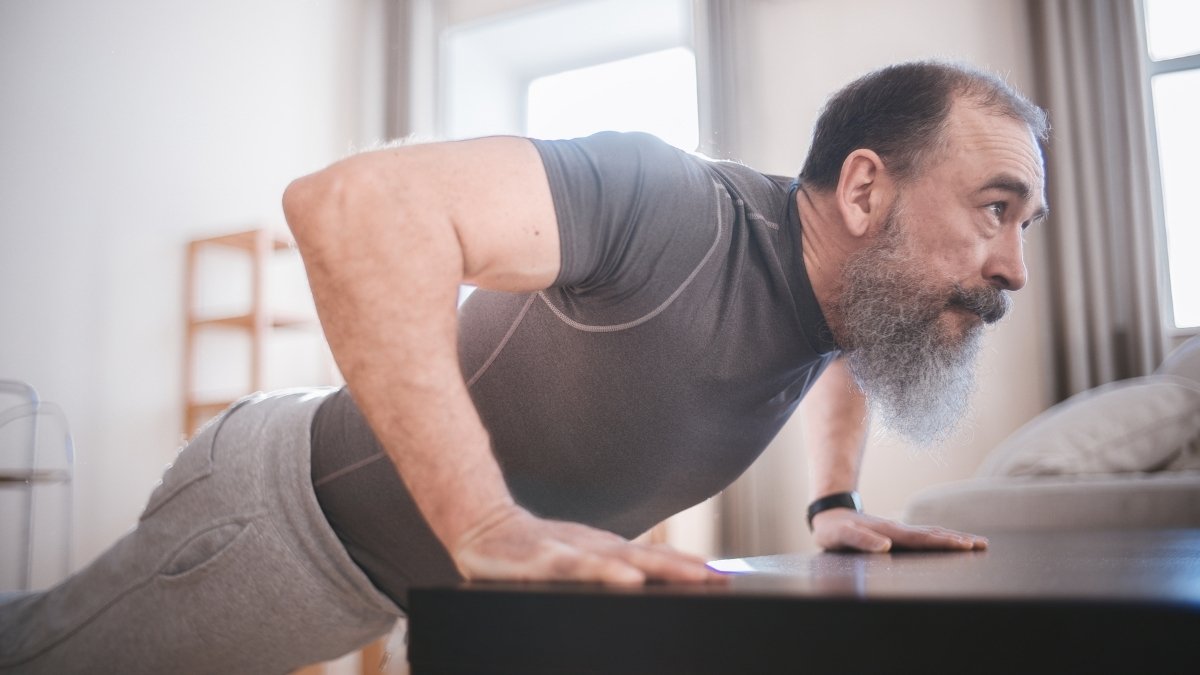
- Push-up (wall, knee, or full) — 3 sets of 8–10
- Row (resistance band, backpack, or dumbbell) — 3 sets of 10
- Hip hinge (deadlift pattern with light weight or no weight) — 3 sets of 10
- Carry (walk while holding something heavy in each hand) — 2 trips of 30 seconds
You don’t need a gym for this. A backpack filled with books works. So does a resistance band or a pair of water jugs.
Test yourself before you start. Time how many times you can stand up from a chair without your hands in 30 seconds. Or squeeze a rolled towel as hard as you can and notice the effort. Retest every 8 to 12 weeks. Small improvements in this number mean your training is working.
Add reps or weight every 1 to 2 weeks, not every session. Your body needs time to adapt. Rushing this only leads to burnout or injury, and neither helps your brain or your muscles.
What to Eat and Do to Make This Work Better
Training alone isn’t the whole story. Your muscles need fuel to make those brain-protecting proteins in the first place.

Protein matters here. Physician Dr. Gabrielle Lyon, who focuses on what she calls muscle-centric medicine, has discussed how skeletal muscle mass affects your immune system, your brain cells, and your hormones, and argues that resistance training should be treated like a prescription, not an afterthought. Acast
Sleep matters just as much. Your muscles repair while you rest. Your brain also uses that same downtime to store new memories. Skimping on sleep undercuts both sides of this equation at once.
You don’t need a complicated diet plan to start. Just make sure protein shows up at each meal, and treat your rest days as part of the plan, not a break from it.
3 Tools That Make This Easier to Track
You don’t need fancy gear. Three simple tools cover everything you need.
A free activity planner. The CDC offers a free tool called the Move Your Way Activity Planner that helps you set goals and track your weekly activity. It costs nothing and takes minutes to set up. CDC
A hand dynamometer. This is a small hand-squeeze device that costs around $15 to $25. It’s the same type of tool researchers used in the studies above. Testing your own grip strength every few months gives you a real number to track.
Any basic fitness app. Pick one with a simple strength-training template built in. You don’t need a premium subscription. You just need something that reminds you to show up twice a week.
The Bottom Line

Your muscles and brain are in constant contact. Weak grip strength predicts real risk. Strength training, done just twice a week, improves memory and thinking in actual trials. Start with two short sessions this week. Retest your strength in three months. Small, steady effort protects both your body and your mind.