
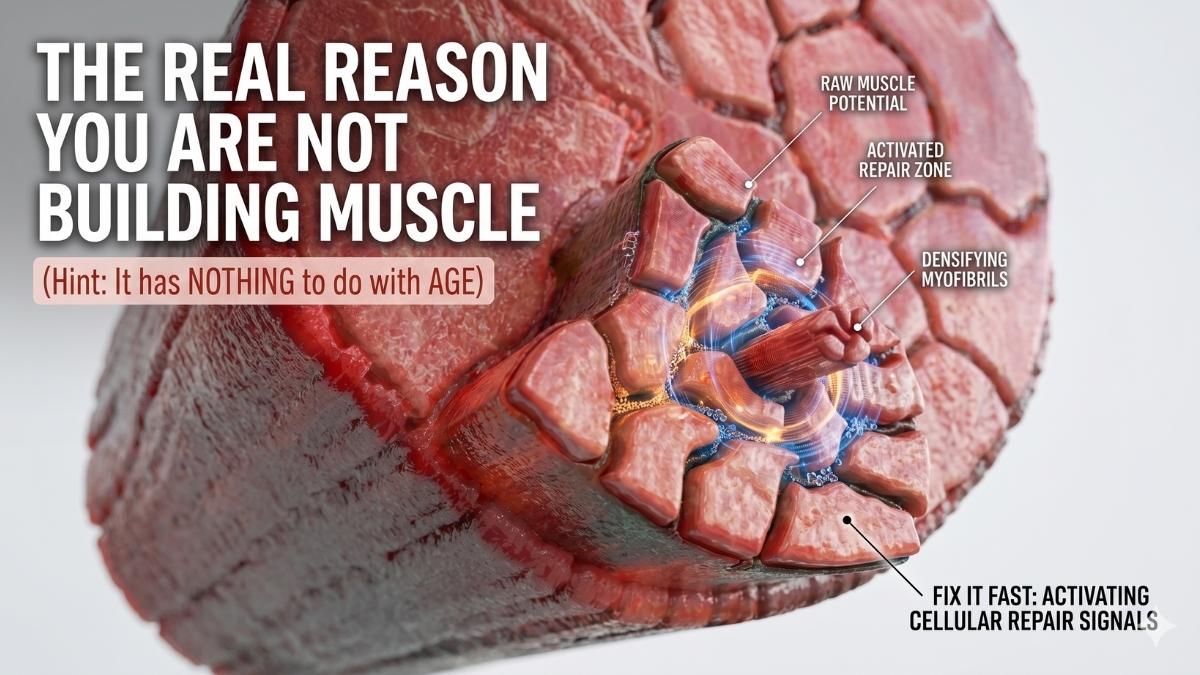
You have been showing up at the gym for months. You are eating chicken and rice. You are doing the work. But your body looks exactly the same as it did six months ago.
So you started blaming your age.
Here is the truth — age is not your problem. The real blockers are six specific habits you can fix starting today. Each one is backed by real research. Each one has a clear, simple solution.
You do not need a new program. You do not need expensive supplements. You just need to fix what is actually broken.
Exactly Why Muscle Growth Has Stopped
Point One — Your Body Has No Raw Materials to Build Muscle With

Building muscle is like building a house. It does not matter how hard the construction crew works. If there are no bricks on-site, nothing gets built. Your calories are the bricks.
Many people eat clean but still under-eat. They think eating healthy is enough. It is not. Your body needs a small caloric surplus to actually build new muscle tissue.
Research shows a 10 to 20 percent caloric surplus above your maintenance calories produces the best results. If you maintain on 2,500 calories, try eating 2,700 to 2,800 per day.
Here is where most people go wrong. They add more protein but keep calories low. The body then burns that protein for energy instead of using it to build muscle. You wasted good protein because you were not eating enough total food.
A meta-analysis of 49 studies covering men ages 50 to 83 found they averaged a 2.4-pound lean mass gain when calories and protein were properly controlled. Age was not the barrier. Food was.
Track your calories for three days using a free app like Cronometer or MacroFactor.
If your weight has not changed in a month, you are not eating enough to grow.
Add one small meal or snack daily — a banana with peanut butter works perfectly.
Point Two — Your Protein Strategy Is Built on a Myth Science Has Now Corrected
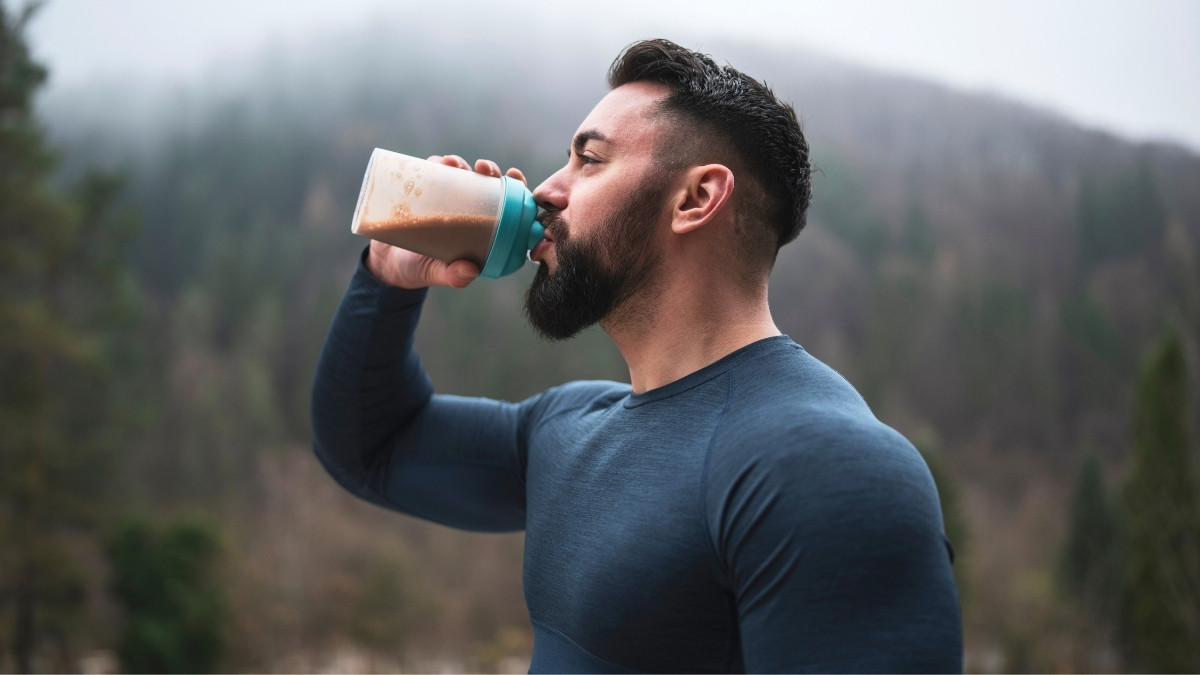
You have probably heard you need one gram of protein per pound of bodyweight. That number has been repeated so many times it feels like fact. But newer research says something different.
Dr. Eric Trexler, a researcher at Duke University, put it clearly. He said the benefit of pushing protein higher beyond a moderate amount is very, very small. So small that many researchers are not even confident the extra benefit exists at all.
The real sweet spot is 0.7 to 1 gram of protein per pound of bodyweight. Spread that across three to four meals daily. That is it.
For people over 50, the body develops something called anabolic resistance. Your muscles become slightly less efficient at using protein. The fix is simple — eat a little more protein and keep doing resistance training. Harvard Health recommends 1 to 1.3 grams per kilogram of bodyweight daily for older adults who train.
Stop chasing the maximum. Start hitting your minimum every single day. Consistency beats perfection here.
Aim for 25 to 40 grams of protein per meal, spread evenly through the day.
Prioritize whole food protein sources like eggs, chicken, fish, and Greek yogurt.
If you are over 50, add a leucine-rich food like cottage cheese or whey after training.
Point Three — Doing the Same Workout Every Week Is Maintenance, Not Growth
If your workout looks the same as it did six months ago, your body has no reason to change. Full stop.
Your body adapts fast. Once it adapts, it stops growing. To keep growing, you have to keep giving it a new challenge. This is called progressive overload. It is the most important training principle for building muscle.
Progressive overload does not mean lifting heavier every single week. It can mean adding one extra rep. Resting 10 seconds less between sets. Slowing the lowering phase of a rep to three seconds. Each of these is progress.
Here is a fact that surprises most people. Muscle protein synthesis — the process of building new muscle — peaks at around 24 hours after you train. By 48 hours, it is back to baseline. If you only train each muscle once a week, you are leaving five days of potential growth unused.
A study of adults averaging 55 years old showed significant strength gains from just two short sessions per week done at high effort. Twice a week is enough. Once is not.
Write down what you lifted this week and beat it by one rep or five pounds next week.
Train each muscle group at least twice per week.
Slow your lowering phase to three seconds — this alone adds intensity without adding weight.
Point Four — Muscle Is Not Built in the Gym. It Is Built While You Sleep.

You think muscle is built during your workout. It is not. The workout is just the trigger. The actual building happens while you sleep.
During deep sleep, your pituitary gland releases its largest pulse of growth hormone. This hormone repairs tissue, drives protein synthesis, and burns fat. Without enough deep sleep, this process gets cut short.
A 2021 study published in Physiological Reports found that one single night of no sleep reduced muscle protein synthesis by 18 percent. One night. That same study recorded a 24 percent drop in testosterone and a 21 percent rise in cortisol — the stress hormone that breaks down muscle.
Five nights of only four hours of sleep lowered muscle-building rates even further. The research is from the Journal of Physiology. Exercise helped buffer some of the damage, but it could not fully replace proper sleep.
The American Academy of Sleep Medicine recommends seven to nine hours per night for adults. For people who train regularly, aim for the higher end of that range.
Set a fixed bedtime and stick to it even on weekends.
Turn off screens 45 minutes before bed to protect deep sleep quality.
If you sleep seven hours but feel tired, improve sleep quality before adding more hours.
Point Five — The Stress Hormone Your Body Makes Every Day Is Undoing Your Workouts

There is a hormone called cortisol. Your body releases it when you are stressed, sleep-deprived, under-fed, or overtrained. In short bursts, it is helpful. But when it stays high day after day, it actively breaks down muscle tissue.
Muscle growth needs an anabolic environment — a state where the body is building. Chronically high cortisol creates the exact opposite. It is a catabolic environment, which means your body is breaking things down instead of building them up.
Here is something most gym-goers do not suspect. Training too often without enough rest is itself a cortisol trigger. More gym time is not always better. Your nervous system has limits. When it gets overloaded, it stops prioritizing muscle growth entirely.
Sleep deprivation makes this worse. Research from BodySpec.com shows that people who do not sleep enough eat an average of 300 to 400 extra calories per day, mostly from sugar and fat. So poor sleep adds cortisol, kills muscle growth, and wrecks your diet at the same time.
Rest at least 48 hours before training the same muscle group again.
Take a planned deload week every six to eight weeks of training.
Daily walks, proper food, and consistent sleep lower cortisol better than any supplement.
Point Six — Age Is Not Your Problem. Your Habits Are. And Habits Can Change Today.
Age does slow some things down. That is true and honest. Adults lose roughly three to five percent of muscle mass per decade after age 30, according to WebMD (reviewed April 2026).
But here is what the research actually shows. That muscle loss is dramatically sped up by inactivity, poor eating, and skipping resistance training — not by age alone.
A review of 49 studies covering men ages 50 to 83 found that progressive resistance training produced an average gain of 2.4 pounds of lean body mass. The men built muscle. In their 50s, 60s, 70s, and 80s.
A 2024 study published on the NIH database was direct: the only evidence-based way to reverse age-related muscle loss in humans is physical exercise. Not a pill. Not a hormone injection. Exercise.
There is even a published case study of an 87-year-old bodybuilder who maintained significant muscle mass using resistance training and 1.6 grams of protein per kilogram of bodyweight daily. The science does not support giving up at 45.
Start with two resistance training sessions per week if you are returning after a long break.
Target 1 to 1.3 grams of protein per kilogram of bodyweight daily if you are over 50.
Track strength — not just appearance. Small strength gains mean your body is responding.
Final Words,
You are not building muscle because of six fixable habits — not your age. Eat more. Hit your protein floor. Train with progressive overload. Sleep properly. Control cortisol. And stop blaming the number on your birthday cake.

Pick one point from this article. Fix it this week. Your body will respond.
The real reason you are not building muscle is not written into your DNA. It is written into your daily habits — and habits can change starting right now.