

Recent research found that people with weaker circadian rhythms had nearly two and a half times the risk of dementia. Those whose activity peaked later in the day faced a 45% higher dementia risk.
Your body’s internal clock is quietly determining how fast you age. Most people don’t realize their irregular sleep schedules, late-night screen time, and mistimed meals are accelerating cellular aging and increasing disease risk.
You’ll discover eight evidence-based strategies to reset your circadian rhythm, backed by 2025-2026 research. These show how proper timing of sleep, light, food, and exercise can extend your healthspan and reduce age-related disease risk.
The science is clear. Your circadian rhythm longevity connection is real. And you can fix your circadian rhythm starting today.
Guide Structure
This article is structured into eight key points—read them one by one to understand how aligning your circadian rhythm can support healthier aging.
Point 1: Your Circadian Rhythm Is the Master Aging Regulator
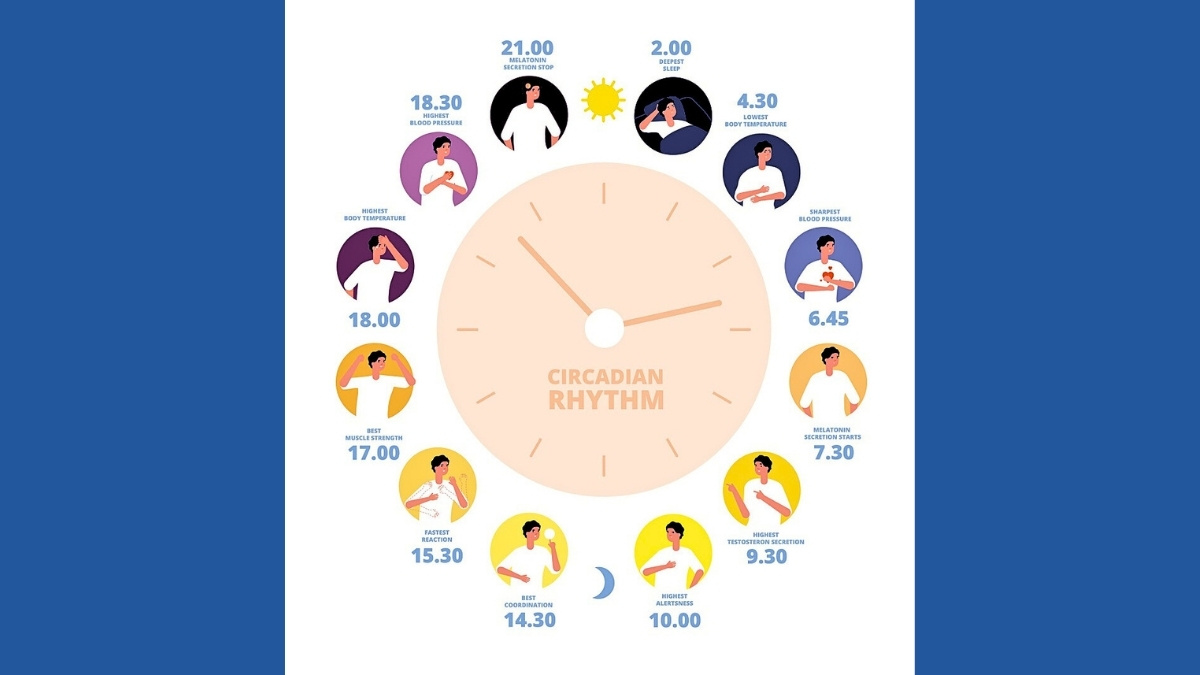
Your body runs on a 24-hour cycle controlled by clock genes like BMAL1 and CLOCK. These genes regulate when your cells repair, when hormones release, and when your body fights disease.
By age 60, your circadian system starts breaking down. Middle-aged adults experience more fragmented sleep and weaker biological clock signals. This decline isn’t random. It directly speeds up aging.
When your circadian rhythm aging process gets disrupted, bad things happen. Your metabolism slows down. Your immune system weakens. Your DNA takes more damage. Disease risk climbs higher.
People in the weakest rhythm group had 54% increased dementia risk per standard deviation drop. Irregular sleep schedules link to higher depression, anxiety, body mass index, insulin resistance, and heart problems.
Your internal clock controls inflammation and oxidative stress. These are the two main drivers of aging. Weaken your biological clock, and you age faster.
Point 2: Get Morning Sunlight Within 30-60 Minutes of Waking

The single most powerful tool to fix your circadian rhythm costs nothing. Morning sunlight resets your internal clock every day.
Get outside for 5-10 minutes on sunny mornings. On overcast days, stay out 15-20 minutes. No sunglasses. Face the direction of the sun without staring directly at it.
Morning light speeds up your circadian cycle. It tells your brain it’s time to be awake. This triggers a 1.5-fold increase in melatonin secretion later that night. Better melatonin means better sleep.
Your body is most sensitive to light in the first 30-60 minutes after waking. Miss this window and you lose the strongest reset signal. Windows don’t work because glass blocks the wavelengths you need.
Use the longest practical duration of bright light as early as possible. Even 5 minutes helps. But 10-20 minutes of morning sunlight circadian exposure gives you maximum benefit.
Point 3: Eat Within an 8-10 Hour Window Aligned With Daylight
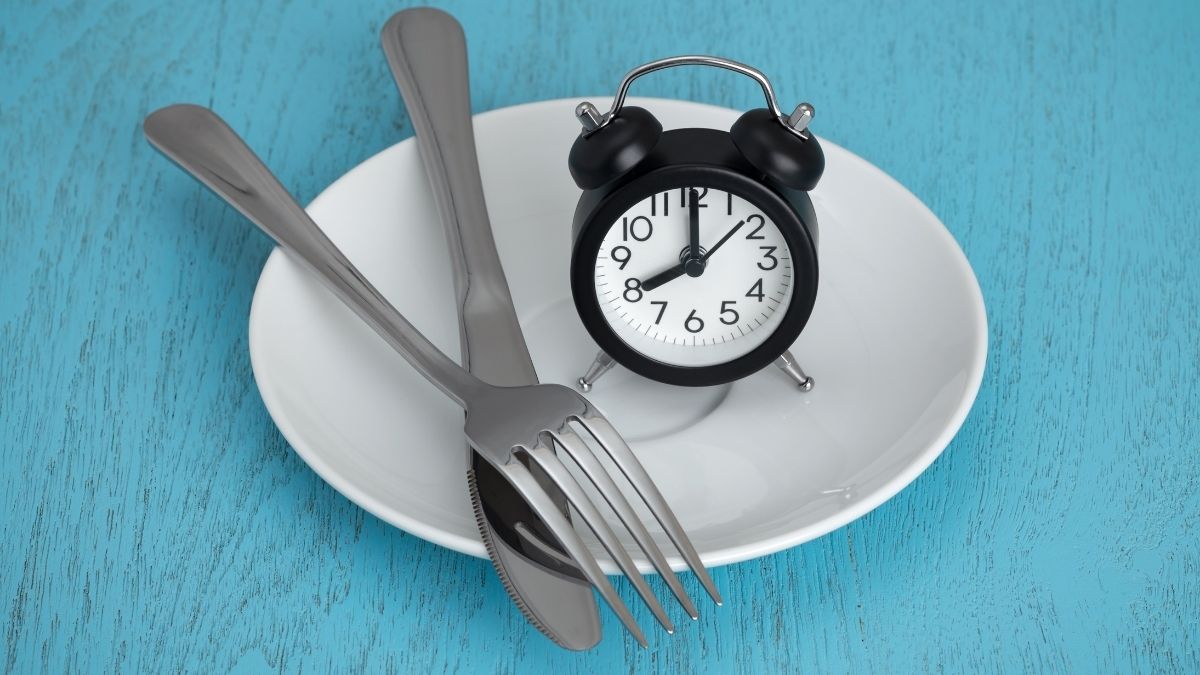
When you eat matters more than you think. Time-restricted eating within 8-10 hours prevents metabolic diseases without cutting calories.
Your body expects food during daylight hours. Eating aligns with your circadian rhythm when you finish your last meal before dark. This enhances weight loss, insulin sensitivity, and glucose metabolism.
Early time-restricted eating works best. Try an 8 AM to 4 PM window. Or 10 AM to 6 PM if you wake later. The key is finishing dinner by early evening.
Research shows time-restricted eating circadian alignment reduces body weight, glucose intolerance, high blood pressure, and high cholesterol. It also improves oxidative stress markers in older adults.
Start with a 10-hour eating window. Eat breakfast at 8 AM and finish dinner by 6 PM. After two weeks, narrow it to 8 hours. Your metabolic health will improve as your meals sync with your internal clock.
Point 4: Maintain the Same Sleep-Wake Times Every Day (Yes, Weekends Too)

Your weekend sleep-in habit might be stealing years from your life. Sleep regularity matters more than sleep duration for longevity.
People with irregular sleep showed 20-88% higher all-cause mortality. They also had worse mental health, metabolic problems, and cognitive decline. The least regular sleepers faced a 26-53% increase in dementia risk.
Pick one bedtime and one wake time. Use them seven days a week. Your body needs consistency to maintain strong circadian rhythms. Weekend catch-up sleep disrupts this alignment.
A 10 PM to 7 AM schedule works for most people. But find what fits your life. The important thing is keeping it the same every day.
Social jetlag happens when your weekend schedule differs from weekdays. This confuses your internal clock. Make changes gradually using 30-45 minute adjustments over several weeks. Your fix circadian rhythm efforts depend on this consistency.
Point 5: Exercise in the Morning to Advance Your Circadian Phase

The same workout delivers different benefits depending on timing. Morning exercise shifts your internal clock forward by 0.62 hours. Evening exercise barely moves it.
A 12-week morning exercise program promotes an earlier sleep-wake cycle and melatonin rhythm. This leads to better sleep quality and faster fat loss. Morning workouts achieve faster reductions in belly fat and significantly lower triglycerides.
This is called chrono-exercise. It’s strategically timed physical activity that strengthens your circadian system. Moderate-intensity aerobic exercise for 30 minutes most days works best.
Exercise 3-4 hours before bedtime to avoid sleep disruption. But if you can only work out at night, do it anyway. Consistency beats perfect timing.
Morning workout timing gives you the best circadian rhythm longevity benefits. Try a 7 AM walk or gym session. Your exercise timing circadian alignment will improve sleep and metabolism together.
Point 6: Dim Lights and Avoid Blue Light 2-3 Hours Before Bed

Every hour of bright light after sunset ages your cells faster. Evening blue light exposure reduces melatonin secretion by 3.7-fold.
Your screens emit blue light that blocks melatonin production. This delays sleep and weakens your circadian rhythm. Night mode on devices helps but isn’t enough alone.
Evening light slows down your circadian cycle when you need it speeding up. In late afternoon, start dimming your environment to follow the sun’s natural rhythm.
Replace bright white bulbs with red or amber ones in evening spaces. Turn off overhead lights 2 hours before bed. Use only dim lamps.
Blue light melatonin suppression is a major fix circadian rhythm challenge. Wear amber glasses if you must use screens at night. Better yet, read a book under a red bulb. Your evening routine should prepare your body for sleep, not fight against it.
Point 7: Use Temperature as a Circadian Cue (Cool Sleeping Environment)

Your body needs to drop 2-3 degrees Fahrenheit to start sleep. Body temperature naturally falls at night as part of your circadian rhythm.
Keep your bedroom cool, around 65-68°F (18-20°C). This helps your core temperature drop faster. Middle-aged adults show phase advances in core body temperature rhythms, making temperature control even more important as you age.
Take a hot shower or bath 90 minutes before bed. This seems backward but it works. The heat brings blood to your skin surface. When you get out, your core temperature drops quickly. This signals sleep time.
Use cooling mattress pads or temperature-regulating bedding if needed. Open windows in winter. Use fans in summer. Your sleep environment temperature is a powerful circadian signal.
Core temperature rhythm is a key circadian marker. Get it right and everything else improves.
Point 8: Eliminate These Common Circadian Rhythm Killers

Certain habits destroy your internal clock without you knowing. Chronic circadian misalignment weakens rhythm amplitude and disrupts your sleep-wake cycle.
Shift work ranks as the worst disruptor. But you don’t need to work nights to have problems. Social jetlag, late-night eating, and meal skipping all cause circadian disruption.
Cut caffeine after 2 PM. It stays in your system for 6-8 hours. Drinking coffee at 4 PM means it’s still active at midnight.
Alcohol suppresses REM sleep and disrupts your circadian timing. It might help you fall asleep but destroys sleep quality. Skip the nightcap.
Consider medication timing too. Some drugs work better at certain times. Ask your doctor if timing matters for your prescriptions.
Permanent standard time would prevent 300,000 stroke cases per year and result in 2.6 million fewer people with obesity. Even daylight saving time disrupts circadian disruptors. Fix circadian rhythm by eliminating these hidden aging accelerators.
Circadian Flow
Conclusion:

Your circadian rhythm is a powerful longevity lever. Implement morning light exposure, time-restricted eating, consistent sleep schedules, strategic exercise timing, and evening light management. These strengthen your internal clock and slow biological aging.
Start with one change tomorrow: get 10 minutes of morning sunlight within an hour of waking. Track your energy and sleep for two weeks. Fixing your circadian rhythm for longevity doesn’t require expensive supplements—just alignment with your biology.